
The Magnetic Fields of Our Solar System

Magnetic fields protect planets and atmospheres from solar particles. The particles from the sun are charged, which means they respond to the magnetic field and move around it. Magnetic fields are generated by the movement of electrically conducting fluid inside the planet, usually in or around the core. Earth’s magnetic field is generated by liquid metal at the core and Earth’s rotation of 24 hours, combined with heat-driven convection of the liquid, produces the movement that sustains a magnetic field. The other planets in our solar system, except for Venus and Mars, all have magnetic fields or traces of magnetism that differ from Earth’s in various ways. So, how are other planetary magnetic fields generated?
Mercury
Earth and Mercury are the only planets in our system whose magnetic fields are generated by the movement of liquid metal at their cores. Mercury’s magnetic field is 100 times weaker than Earth’s. It’s billions of years old and recently discovered data suggests that it may once have been much stronger, possibly comparable to Earth’s.
Venus
While Venus does not have a magnetic field, likely because of it’s extremely slow rotation rate at about 243 Earth days, it’s still protected from solarwinds using a different type of magnetism. It’s upper atmosphere, the ionosphere, interacts with solar particles and acts like a magnetic version of a comet’s tail or a magnetotail. The magnetotail of Venus is shaped like the tentacle end of a jellyfish and faces away from the sun.
Mars
Mars does not have a conventional magnetic field--one that is generated by movement at its core. Instead, Mars has powerful magnetic crustal fields that create fields of magnetism if situated correctly on the surface. To create the protective bubble, the magnetic lines have to connect at two points. In some places these crustal fields act like small shields that can reduce the loss of atmosphere, although in other places they channel particles and can increase escape, and Mars continues to lose atmosphere.
Jupiter
Jupiter, the largest planet in our solar system, also has the largest magnetic field, generating a magnetosphere larger than the Sun. It’s magnetic field is driven in part by its fast rotation of 9.9 Earth hours. Unlike Earth, Jupiter’s magnetic field is not generated from it’s core but by interactions in it’s outer core, which consists of liquid metallic hydrogen. Jupiter’s core is not a small, sharply bounded ball. NASA's Juno data suggest a large, “fuzzy” or dilute core, with heavy elements gradually mixed into the surrounding hydrogen, although its exact size and makeup are still uncertain.
Saturn
Saturn is one of the only planets whose magnetic field lines up with its axis of rotation. It’s field is generated by liquid metallic hydrogen, circulating a rocky core. Its core is heated by gravity pulling helium toward the core, and its rapid rotation at about 10.7 Earth hours.
Uranus
The magnetic field of Uranus is a little more complicated than the other planets. Uranus’ magnetic field tilts dramatically and does not align with the rotation axis by about 59 degrees. The magnetic field also runs off center through the planet. The field is not a simple dipole. It is a blend of a tilted, off-center dipole (two poles) and a quadrupole (four poles) of similar strength, so the field strength varies widely across the planet's surface. Uranus meets the two usual requirements for a magnetic field with a rotation period of about 17 Earth hours and electrically conductive convection currents in its interior. Scientists believe that Uranus’s odd magnetic field could be caused by the electrical currents in the salty ocean within the planet.
Neptune
Neptune’s magnetic field is generated within the planet’s interior. Like Uranus, however, Neptune’s magnetic field is significantly off-center and tilted away from its axis of rotation. Because the magnetic field line is offset, scientists believe that Neptune, like Uranus, has magnetic or electrical interactions occurring closer to the surface of the planet. If the magnetic field were generated at it’s core, the magnetic field would be more likely to go directly through the center of the planet as it does for Earth.
Of all of these natural magnets, the Earth’s magnetic field is the most important to our existence. If Earth didn’t have a magnetic field, we would be in trouble. The magnetic field protects us from harmful radiation from the Sun and helps shield our atmosphere from the solar wind. If you want to know more about magnets in space feel free to contact us.
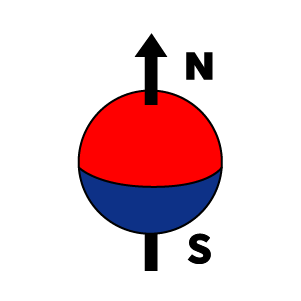
Image by Kwamikagami

-
Gauss Spectrum Magnetic Field Viewer Film - 8 x 11.75

- 1 Piece Gauss Spectrum Magnetic Field Viewer Film
- Display relative gauss strength in a spectrum of color
- SKU# GSVF
$54.99 As low as $46.74 -
1/2 Inch Neodymium Sphere Magnet N48 (4 Pack)

- 4 magnets
- Pull Force: 7.38 pounds per magnet
- SKU# M12SP
 $17.99 As low as $12.59
-
Ferrofluid Magnetic Liquid ***1 Ounce***

- 1oz bottle of Ferrofluid
- This liquid responds to magnets and magnetic fields
- Mineral oil based product
- SKU# FF1oz
$20.99 As low as $16.79