
Thank Nickel for Earth’s Magnetic Field

Earth’s core is mostly comprised of iron, with a solid inner core and a molten outer core. Iron is ferromagnetic at ordinary temperatures. However, iron alone does not make for a great magnetic field. It turns out iron gets some pretty crucial help from an old, elementary fried—nickel.
Let’s start with the bigger question. Why is Earth’s magnetic field so important? Simply put, if it weren’t for our planet’s magnetic field, we’d all be zapped by the sun’s radiation and any and all life would not exist. The magnetic field creates a barrier, one that solar wind cannot completely penetrate. Because the field deflects most of these charged particles, our atmosphere is able to thrive and help the atmosphere retain essential components of life, like oxygen.
Another fun effect of Earth’s magnetic field? The aurora borealis and aurora australis—the northern and southern lights. These magical streams of colorful light dance across the polar skies because of charged particles from the sun colliding with gases in our upper atmosphere.
How Earth’s Core Makes a Magnetic Field
Bringing things back down to Earth, let’s discuss how our magnetic field is generated in the first place. The magnetic field is possible because of the Earth’s dynamo effect—at least this is the leading theory. No one can say for sure. However, the dynamo theory states that Earth’s liquid outer core can circulate deep underground. This circulating, electrically conducting metal drives electric currents. Because the outer core is far too hot for iron to be ferromagnetic, the magnetic field comes from those currents.
However, there’s a bit more to it than that. According to findings reported by Laboratory News, a 2017 computer-simulation study in Nature Communications suggests that nickel, which makes up as much as about 20% of the core, plays a crucial role in the dynamo effect. How large nickel's effect is remains under study.
What Can Nickel Do for You?
So what makes nickel such a special ingredient in Earth’s core? It all comes down to the humble little electron. In case you’re a little rusty on your junior high chemistry, electrons are subatomic particles that orbit the nucleus and provide an atom’s negative charge. According to the researchers’ simulations, at the extreme pressures of the core, electrons in an iron-nickel alloy scatter much more strongly than in pure iron, which suggests a much lower thermal conductivity.
Again, what makes this a big deal? Because nickel scatters electrons, the iron-nickel alloy conducts heat less well than pure iron. This may lower the thermal conductivity of the core. In other words, nickel’s wandering electrons may help slow heat loss from the core.
Because nickel cuts down on the thermal conductivity, this heat cannot escape the core as easily. This helps drive convection in the liquid outer core, which together with Earth rotation sustains the dynamo effect and ultimately providing us with our totally necessary magnetic field. The next time you pull out a 5-cent coin (75% copper, 25% nickel), take a moment to thank the amazing properties of nickel for keeping our planet green and habitable.
Want more strange and amazing magnetic facts? Make sure to check out the rest of our blog and follow us on Twitter!
-
Buzzing Ball Hematite Sphere Magnets "Rattlesnake Eggs"

- 1" diameter · 25.4 mm
- 2 magnets
- SKU MhemSP
per pack · $3.00 per magnetSpecial Price $5.99 Regular Price $8.99 -
12" x 12" Magnetic Field Viewer Film

- 1 Piece Magnetic Field Viewer Film
- The poles appear dark green
- SKU# VF12
$49.99 -
1/2 Inch Neodymium Sphere Magnet N48 (4 Pack)
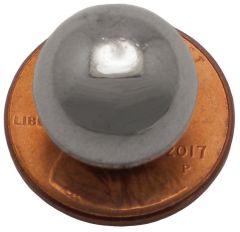
- 1/2" diameter · 12.7 mm
- 7.38 lb pull per magnet
- 4 magnets
- SKU M12SP
per pack · $4.50 per magnet$17.99