
Unveiling Complexity in Jupiter’s Magnetic Equator
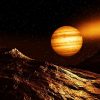
There’s more to Jupiter than what meets the eye. At least, that’s what planetary scientists recently discovered when they stumbled upon a mysterious dark “ribbon” around Jupiter’s magnetic equator. This ribbon, created by interactions between the planet’s magnetic field and ionosphere, was found by a team led by University of Leicester planetary astronomer Tom Stallard.
A Magnetic Discovery
To study the planet’s magnetic field, Stallard and his colleagues stitched together 13,501 images taken of Jupiter between 1995 and 2000. These infrared images of H3+ emission were taken from the ground over 48 nights, originally in support of NASA’s Galileo mission, and their field of view was wide enough to show the entire planet, making them a tedious but useful tool for discovery. The team then studied infrared emissions from H3+ ions using an NSFCam instrument at the NASA InfraRed Telescope Facility. This discovery of the “ribbon” became the first evidence of a localized ionospheric interaction with Jupiter’s magnetic field.
They also observed other localized dark regions around the planet, including an area identified as the Great Cold Spot. This spot is thought to be a consequence of Jupiter’s magnetic field due to the polar aurorae, whose energy input heats the upper atmosphere and drives atmospheric circulation that can leave cooler regions in the thermosphere. Their discovery provides empirical evidence for future ionospheric and magnetic field models.
The Importance of the Ionosphere
Until this discovery, studies of Jupiter’s ionosphere focused on the poles of the planet. Previous studies found that the ionosphere was smooth; this study, however, uncovered the complexity of the ionosphere and its interaction with the magnetic equator. Studying Jupiter gives us insight into how to understand our planet, specifically when looking at the ionosphere. Earth's ionosphere also shows structure organized around its magnetic equator, such as the equatorial ionization anomaly, though this is only a loose analogy to Jupiter's dark ribbon.
For more up-to-the-minute magnetic stories, including how Jupiter's moon has a magnetic field and Mars is missing one, visit our blog and make sure to check out the newest products in our online catalog today!
-
Magnetic Pole Searcher/Finder
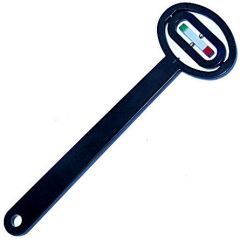
- 1 North/South Pole Magnet Identifier
- The unit consists of a small alnico bar magnet that is gimbal mounted
- SKU# MPS
$10.99 -
Buzzing Ball Hematite Sphere Magnets "Rattlesnake Eggs"
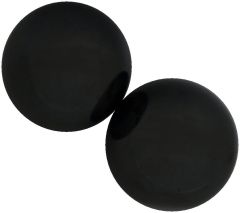
- 2 magnets
- Material: Hematite
- SKU# MhemSP
 Special Price $5.99 Regular Price $8.99