
When to Use Ring Magnets Instead of Countersunk Magnets

Countersunk magnets are a form of ring magnet (although we also sell countersunk blocks!) with a conical (countersunk) recess to take in a screw head flush, allowing it to be anchored onto another surface. They’re ideal for hanging artwork and keeping doors and drawers closed. On the other hand, traditional ring magnets have concentric, non-angled holes. They’re not as strong as, say, disc magnets, but they are versatile and can slide quite easily onto rods and tubes.
When it comes to using magnets with holes in the center, do you know when you should use rings instead of countersunk? Here are three examples:
3 Ways to Use Ring Magnets
1. To demonstrate repulsion.
During science class, teachers often use ring magnets to demonstrate magnetic repulsion. First, wooden poles are threaded through the rings. Then, when the same poles of the magnet face each other, they won’t touch.
2. To clean glass.
Whether you’re cleaning a vase, a fish tank, or a window, the process is simplified with ring magnets. Cut a sponge in half and insert a ring magnet with string tied to it into each half. Once you add soap and/or water, you can pull your sponge along as it cleans both the inside and the outside of a glass surface.
3. To temporarily suspend shock therapy in implantable cardioverter-defibrillators (ICD), under medical supervision only.
That’s right, ring magnets can be used in medicine, too! Clinicians and emergency responders sometimes place a ring (doughnut) magnet over an ICD to temporarily suspend its shock therapy, for example when a device is delivering inappropriate shocks. While the magnet is in place the ICD stops detecting dangerous rhythms and delivering shocks, but its pacing function is not affected. Normal operation resumes when the magnet is removed, and a few devices do not respond to magnets. This should only be done by or under the direction of medical professionals.
More to Know About Ring Magnets
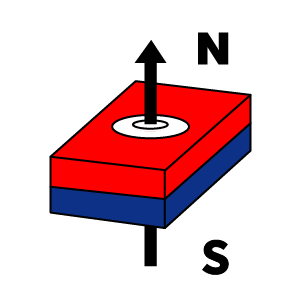
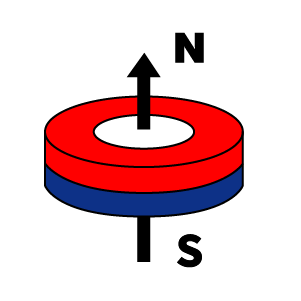
Something to keep in mind about ring magnets is that they can be magnetized in several patterns, such as axially, diametrically or with alternating pole segments around the ring. In multipole rings, the alternating segments can be divided into halves, quarters or eighths.
Apex Magnets
Ultimately, ring magnets are particularly useful for science projects and manufacturing. However, as always, we believe you’re only limited by the bounds of your own imagination. If you want to talk about other applications for ring magnets, leave us a message or give us a call at 1-304-257-1193.
-
1 x 1/2 x 1/8 Inch Neodymium Countersunk Block Magnet N48 (2 Pack)
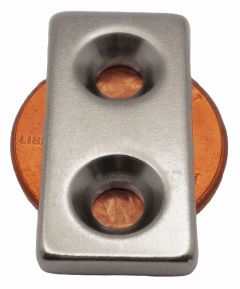
- 2 magnets
- Pull Force: 9.20 pounds per magnet
- SKU# M1x12x18CSB
 $5.99 As low as $4.19
-
1/2 x 1/4 x 1/8 Inch Neodymium Ring Magnet N48 (10 Pack)
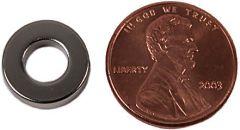
- 10 magnets
- Pull Force: 6.06 pounds per magnet
- SKU# M121418R
 $10.99 As low as $7.69
-
3/8 x 1/8 Inch Neodymium Countersunk Ring Magnet N48 (8 Pack)
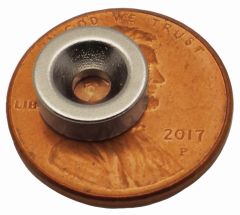
- 8 magnets
- Pull Force: 3.60 pounds per magnet
- SKU# M38x18CSR
$8.99 As low as $6.29