
Why September Is a Great Time to Learn About the Northern Lights
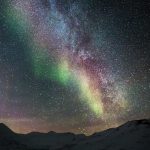
Magnets and the Northern Lights have an incredible connection that can turn a colorful night sky into a hands-on STEM lesson. Also known as the aurora borealis, the Northern Lights let us explore Earth's magnetic field, the Sun, our atmosphere, and the science behind those brilliant colors.
September is an especially fitting time to explore the topic. According to the National Oceanic and Atmospheric Administration (NOAA), the periods around the spring and fall equinoxes tend to be good seasons for aurora viewing. This is because interactions between the solar wind and Earth's magnetosphere can increase geomagnetic activity around the equinoxes.
So, what do magnets have to do with those colorful lights in the sky?
What Causes the Northern Lights?
It all starts about 93 million miles away with the Sun.
The Sun constantly releases a stream of charged particles called the solar wind. When that solar wind reaches Earth, it interacts with Earth's magnetic field.
Earth essentially behaves like a giant magnet, with a magnetic field extending far into space. That field plays an important role in how charged particles move around our planet.
During auroral activity, energetic particles travel along Earth's magnetic field lines toward the polar regions. When they reach the upper atmosphere, they collide with gases such as oxygen and nitrogen. Those collisions transfer energy to the gases. When the gases release that extra energy, they produce light.
The result is the colorful display we call an aurora.
Why Are the Northern Lights Different Colors?
Here's another STEM lesson hiding in the night sky: the colors of an aurora can tell scientists what's happening high above Earth.
When energetic particles interact with gases in Earth's upper atmosphere, they transfer energy to atoms and molecules such as oxygen and nitrogen. As those gases release the extra energy, they emit light at particular wavelengths, which we see as different colors.
- Green is the most common aurora color. It usually comes from oxygen at altitudes of roughly 60 to 190 miles above Earth.
- Red can also come from oxygen, but it typically appears much higher in the atmosphere. At these higher altitudes, the conditions allow oxygen to release energy differently, producing a red glow.
- Blue and purple are generally associated with nitrogen and tend to appear at lower altitudes. When different emissions occur together, they can also create pinks and other blended colors along the edges of an aurora.
That means an aurora's colors aren't simply there to put on a beautiful show. They can also provide clues about which gases are interacting with energetic particles and where those interactions are taking place in the atmosphere.
So when you look at a photograph of the Northern Lights, you can try reading the colors like scientific clues. A bright green band, a red glow overhead, or a purple edge can each tell part of the story of what's happening in Earth's upper atmosphere.
Try It: Explore an Invisible Magnetic Field
We can't recreate the Northern Lights with a magnet at home, but we can investigate one of the important scientific concepts behind them: magnetic fields.
You'll need:
- Bar magnet (use a bar magnet with the polarities on the ends instead of the large flat side.)
- Small compass
- Sheet of paper
- Pencil
Step 1: Place the bar magnet flat on a table and put the sheet of paper over it.
Step 2: Place the compass near one end of the magnet and observe which direction the needle points.
Step 3: Move the compass to another position around the magnet. Watch how the direction of the needle changes.
Step 4: Use your pencil to make small arrows showing the direction the compass points at different locations.
Step 5: Continue moving around the magnet. Can you begin to see a pattern?
You can't see the magnet's magnetic field with your eyes, but the compass allows you to observe its effects.
Now think bigger. Much bigger.
Earth also has a magnetic field extending into space. The Northern Lights offer a spectacular example of what happens when particles from the Sun interact with our planet's magnetic environment.
Keep Exploring Magnetism
The next time you see a photo of green and purple lights dancing across the night sky, remember that you're looking at much more than a beautiful natural phenomenon. You're seeing physics, chemistry, astronomy, and magnetism come together.
September's fall equinox makes it a great time to look up, get curious, and explore the science behind the aurora borealis.
Want to keep the STEM learning going? Explore Magnetic Experiments on our blog for more hands-on experiments that help kids investigate magnetic attraction, poles, magnetic fields, and more. If you have questions, reach out anytime!
Vocabulary
- Aurora Borealis: The Northern Lights, a colorful display of light produced when energetic particles interact with gases in Earth’s upper atmosphere.
- Magnetic Field: An invisible region around a magnet or magnetic object where magnetic forces act.
- Magnetosphere: The region around Earth that is strongly influenced by Earth’s magnetic field.
- Solar Wind: A continuous stream of charged particles flowing outward from the Sun.
- Charged Particle: A tiny piece of matter, such as an electron or proton, that has an electric charge.
- Magnetic Pole: A region where a magnetic field is strongest. Magnets have north and south poles.
- Atmosphere: The layers of gases surrounding Earth.
- Geomagnetic Storm: A disturbance in Earth’s magnetosphere caused by activity from the Sun that can increase aurora activity.
Safety Warning: Children should not be allowed to play with neodymium magnets as they can be dangerous. Small magnets pose a choking hazard and should never be swallowed or inserted into any part of the body.
Magnets can be dangerous. Neodymium magnets, especially, must be handled with care to avoid personal injury and damage to the magnets. Fingers and other body parts can get severely pinched between two attracting magnets. Bones can be broken by larger magnets. Visit our Magnet Safety page to learn more.