Magnet Experiments
-
Copper Tube and Neodymium Magnet Experiment Explained
 In a previous blog, we completed a neodymium magnet experiment to see what happens when you drop a bar magnet into a copper tube. Spoiler alert — if you want to try the experiment for yourself first, stop reading and head to this blog. When you complete the age-old “drop a magnet down a tube” trick, you’ll notice something strange...
 -
Magnet Experiment: How to Make an Electromagnet
 The discovery that electricity and magnetism are closely related goes as far back as the 1820s, when physicist Hans Christian Oersted demonstrated that an electrical current creates a magnetic field capable of deflecting a compass needle. Oersted’s discovery established that there is more than just one type of magnet. Continue reading →
 -
Magnetic Experiment and Lesson Ideas
 Magnetism is all around us. It is one of the greatest scientific and natural phenomenons in the world and an important part of science and other learning curriculum. However, it can get a bit complex, so how do we teach students about magnetism without confusing or boring them? Here are a few suggestions and lessons to try to engage and introduce students to the magical world of magnets. Continue reading →
 -
Magnet Experiments: Iron Filings and Neodymium Magnets
 Iron filings are, as their name suggests, filed pieces of iron that look like a metallic powder. Their properties are, in some aspects, similar to ferrofluid, because they form a significant pattern when interacting with a magnet. Magnetic fields are invisible, but the pattern that both substances form represents the lines of a magnetic field. Pairing iron filings and magnets together is probably one of the most common, preliminary experiments used to show magnetism. Despite its commonality it is still an interesting way to display the magnetic field. Conduct your own experiment with iron filings and these simple steps! Continue reading →
 -
Magnet Experiments: Magnetic Levitation of a Superconductor
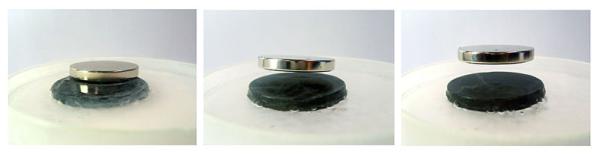 In a previous blog we discussed and conducted an experiment showing diamagnetic levitation, the phenomenon that happens when diamagnetic materials levitate in between an arranged magnetic field. In this blog, we’re discussing superconducting levitation with magnets. Superconducting levitation, also known as the Meissner effect, can be considered a “super” form of diamagnetic levitation. A superconducting material like Yttrium-barium-copper-oxide enters a state of zero electrical resistance when it reaches its superconducting point. This state seems to defy gravity by repelling magnetic fields and levitating. In this example, the temperature needed to become a superconductor with perfect diamagnetism is around 93 Kelvin or -180° Celsius. Continue reading →
 -
Magnet Experiments: Opening a Bottle with a Quarter and a Magnet
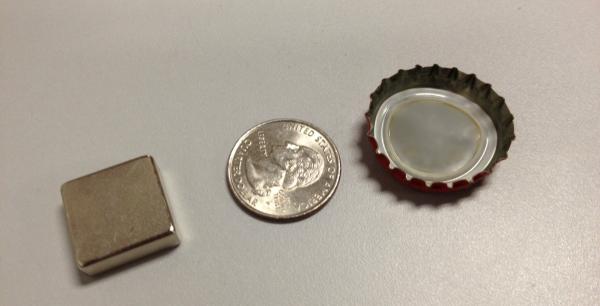 You may have seen a video that shows a bottle cap being popped off using only a fridge magnet and a quarter. The video has been circling the Internet recently and may seem real, but we were pretty skeptical. As magnet-enthusiasts, we naturally had to test out the legitimacy of this bottle opening trick. Continue reading →
 -
Magnet Experiments: What Happens to a Magnet in Cold Temperatures
 High powered magnets can lift cars, and steel beams as well as crush bones or break glass. In other words, magnets are capable of some incredible feats. However, there are a few things that can alter magnet strength. One of those is temperature. In our last blog we explored what happens to a magnet when it is exposed to extreme heat. Now, let’s do an experiment to explore what happens to a magnet when it is exposed to extreme cold. Continue reading →
 -
Magnet Experiments: What Happens When a Magnet is Heated
Magnets can be found in many everyday items and technologies such as cars, phones and computers. It is because of permanent magnets' ability to create their own magnetic field that they are useful in various products and situations. However, they are not impervious. Magnet strength can be affected by certain environmental changes like temperature. The effect of temperature on neodymium magnets is one of the most interesting phenomenons to observe and evaluate. In this magnet experiment, we specifically explore how magnets react when exposed to extreme heat. Continue reading → -
What Will Happen to a Magnet in Water
Will a neodymium magnet lose its power when dropped in water? The simple answer is no. In fact, magnets are sometimes used for underwater recovery. Boaters and fisherman may use a magnet retrieval tool to recover some lost items such as keys or magnetic fishing gear that have been dropped in the water. However, one concern is that the magnets will begin to corrode, especially if they are made of materials like neodymium. On the other hand, water has shown diamagnetic properties. Continue reading → -
Make a Homopolar Motor with Neodymium Magnets
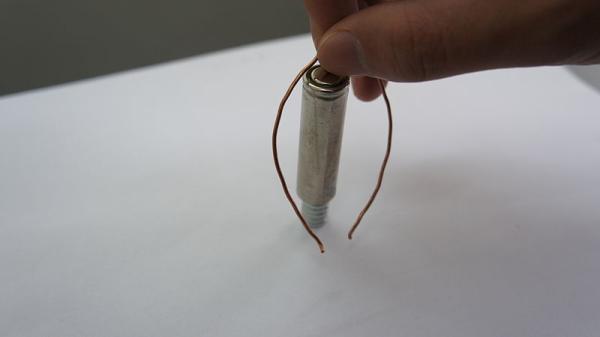
The homopolar motor, the simplest electric motor, was first demonstrated by Michael Faraday in the early 1800s. His demonstration showed how electromagnetism can support motion, but the design used mercury and was not advanced enough to be used for any practical application. Nevertheless, his finding made the many advanced motor-based technologies that we see today possible. Today, magnets are used in electric motors to assist in transferring electrical energy to mechanical energy. Continue reading →