
Why Does Kīlauea Volcano Have an Unusual Magnetic Field?
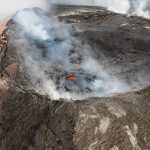
Located on the Island of Hawaii, Kīlauea is one of the world's most active volcanoes and one of six volcanoes that have formed the island. It is a shield volcano, built over time by repeated flows of primarily basaltic lava.
Because Kīlauea has erupted frequently, it provides scientists the opportunity to study volcanic activity, lava flows, and the geology beneath the surface. It's also an ideal place to explore another fascinating (and our favorite) feature of volcanic landscapes: magnetism.
Why Is Volcanic Rock Magnetic?
Basaltic lava in Hawaii contains iron-bearing minerals. While lava is extremely hot, its magnetic behavior differs from that of the solid rock it eventually becomes. As lava cools, magnetic minerals can acquire a lasting magnetization influenced by Earth's magnetic field at that time.
This process is called thermoremanent magnetization.
In a sense, cooled lava can preserve information about Earth's magnetic field when the rock formed. That's one reason paleomagnetism, the study of magnetic information preserved in rocks, can help scientists investigate the history of volcanic landscapes and Earth's magnetic field.
Lava Records Earth's Magnetic Field
As lava cools below critical temperatures, magnetic minerals within it can preserve the direction of Earth's magnetic field. Scientists can collect samples from lava flows and measure their remnant magnetization in a laboratory. When combined with geologic mapping, geochronology, and other evidence, paleomagnetic measurements can help researchers correlate and constrain the ages of different lava flows.
What Makes Kīlauea's Magnetic Anomaly Unusual?
The USGS Hawaiian Volcano Observatory has monitored magnetism at Kīlauea since the 1950s. Magnetic surveys around the Hawaiian volcano have revealed unusual patterns, including magnetic highs and lows that can hint at volcanic rock, heat, hydrothermal alteration, and structures hidden beneath the surface.
Magnetic anomalies aren't unique to Kīlauea. Volcanoes worldwide can produce variations in the local magnetic field because volcanic rocks contain magnetic minerals. Differences in rock composition, temperature, hydrothermal alteration, and underground structures can all affect the magnetic patterns scientists measure above them.
What makes Kīlauea particularly interesting is the magnetic pattern researchers have measured around its summit.
Kīlauea's Magnetic Pattern Is Opposite What Researchers Would Normally Expect
Kīlauea's basaltic rocks can become strongly magnetized as lava cools. Given the direction of Earth's present magnetic field in Hawaii, normally magnetized volcanic rock beneath Kīlauea should create a magnetic high to the south and a low to the north. However, surveys around Halemaʻumaʻu, a crater within Kīlauea’s summit caldera, measured the opposite pattern: a low to the south and a high to the north.
At first glance, that pattern could suggest that some of the rock beneath the summit became magnetized when Earth's magnetic field pointed in the opposite direction. However, the shallow volcanic rocks involved are younger than Earth's last major magnetic reversal, the Brunhes Matuyama reversal, which happened approximately 780,000 years ago. This means its unusual magnetic pattern should not be interpreted simply as a large body of lava that solidified when Earth's magnetic poles reversed.
That led researchers to investigate another explanation.
A Weakly Magnetized Zone May Be Hiding Beneath the Crater
Using three-dimensional modeling of magnetic measurements collected around the summit, researchers found evidence of a substantial volume of weakly magnetized material beneath Halemaʻumaʻu.
The surrounding basalt is relatively strongly magnetized. A large area of weaker magnetization within that environment can therefore create a distinctive magnetic contrast that instruments detect at the surface.
Researchers identified two important possibilities that would cause underground material to be less magnetic: high temperatures and hydrothermal alteration.
High temperatures can reduce volcanic rock's magnetization. Hot fluids circulating through cracks can also chemically alter magnetic minerals, reducing their magnetic properties. Kīlauea's summit is both volcanically hot and hydrothermally active, making both processes plausible contributors.
Interestingly, the weakly magnetized areas researchers identified also correspond to geological structures that may have acted as zones of weakness during Kīlauea's dramatic 2018 summit collapse.
Can Scientists Use Magnetism to Monitor Volcanoes?
Magnetic measurements can contribute to volcano research and monitoring, but they are only one part of a much larger monitoring system.
Scientists have studied changes in magnetic fields associated with volcanic processes for decades. At Kīlauea, researchers have investigated whether magnetic changes related to heat, stress, magma movement, and other subsurface processes can provide useful information about volcanic activity.
Modern researchers use sensitive magnetometers and carefully designed surveys to measure small variations in magnetic fields. These measurements can complement other volcano monitoring techniques, including earthquake detection, ground deformation measurements, gas monitoring, thermal observations, and geological mapping.
What Can Kīlauea Teach Us About Magnetism?
Kīlauea provides a fascinating real-world example of how magnetism connects geology and physics.
Its lava contains magnetic minerals. Those minerals can preserve information about Earth's magnetic field as the lava cools. Heat can change the magnetic behavior of volcanic material, while hydrothermal alteration can weaken rock magnetization. Scientists can measure these differences to learn more about structures they can't directly see underground.
At Apex Magnets, we're fascinated by the ways magnetism appears throughout the world around us. Explore more magnet science, experiments, and real-world applications on the Apex Magnets blog. If you have any questions, please contact us.