
Magnets in Wristwatches: What is the Lavet-Type Stepping Motor?

Did you know there is still a significant market for quartz analog wristwatches, even in the era of smartwatches? Grand View Research estimated the global quartz watch market at about $15.3 billion in 2024, and its U.S. quartz estimate for the same year was about $2.1 billion. Analog watches (mechanical and quartz together) made up roughly 93% of U.S. watch revenue in 2024, according to the same firm. Estimates of the overall conventional watch market vary by firm, with one 2024 estimate at about $66.4 billion. Published 2024 estimates for the global smartwatch market range from roughly $37 billion to $46 billion, so conventional watches remain the larger market.
What’s even more interesting is that the analog quartz watches of today are basically unchanged from the first designs, introduced more than 55 years ago by a Swiss consortium and a Japanese watchmaker, Seiko. Both those watches and today’s modern version use something called a Lavet-type Motor. Invented by French engineer, Marius Lavet, the Lavet motor can only turn in one direction, which is dependent on the geometry of the stationary element (the stator) surrounding the magnetic rotor.
However, the long-unchanged analog quartz wristwatch may finally get some technological updates in the form of silicon microelectromechanical systems (MEMS) motors that are about half the size of the standard Lavet stepper motor currently used, which already uses a miniaturized magnet as its rotor. Unlike the Lavet motor, these MEMS motors are electrostatic and do not use magnets. The future of such advancements remains to be seen.
How Does the Historical & Modern Lavet Work?
Used in a single-phase Lavet-type stepping motor, permanent magnets function as rotors. As mentioned, it can only turn in one direction, which is dependent on the geometry of its stator, the stationary element surrounding the magnetic rotor. A circuit is then used to generate a bipolar pulse, meaning it delivers both positive and negative voltage to the coil in short intervals. When the electromagnet is turned on, it acts on the rotor’s magnetic poles.
Another essential element of the Lavet motor is the cogging points (angles where the volume of air between the magnetic rotor poles and the bulk of the stator is reduced). These can differ depending on whether the stator coil is energized or not. With no current flowing, the magnetic rotor is held at rest positions set by the stator’s shape (cogging, or detent, torque), where the magnetic reluctance is lowest.
Here is the movement process in the Lavet motor:
- Currentless stator; rotor’s north pole points to the upper left.
- Energized status; rotor moves clockwise; the north pole points to the right.
- As energization declines, the rotor moves further and settles into its next rest position, half a turn from where it started.
- Stator energized in the opposite direction; rotor moves clockwise; north pole points left.
- After energization declines, the rotor returns to its original position.
Ultimately, in order to make the Lavet motor rotate, the current sent through its stator coil needs to change direction at each step (i.e., bipolar), followed by an interval without current when the rotor settles into a minimum-reluctance (rest) position.
Apex Magnets
For companies that create analog or stepped-movement quartz clocks (including wristwatches), magnets are an important element of manufacturing, and they remain essential in the Lavet motors that drive today’s analog quartz watches. As the world of technology and manufacturing evolves, you can count on us to keep you informed on the best ways to employ magnets. If you are looking to purchase magnets today, don’t forget to browse our product catalog.
-
3 x 1 mm Neodymium Disc Magnet N48 (100 Pack)
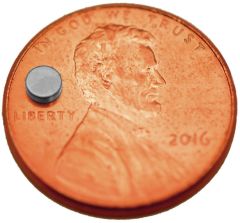
- 100 magnets.
- Pull Force: 0.27 pounds per magnet
- SKU# M3X1MMDI
 $6.99 As low as $4.89
-
2 x 1 mm Neodymium Disc Magnet N48 (100 Pack)
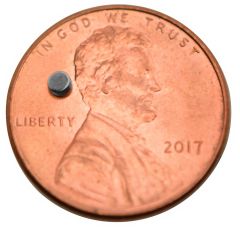
- 100 magnets.
- Pull Force: 0.13 pounds per magnet
- SKU# M2x1MMDI
$6.99 As low as $4.89 -
2 x 0.5 mm Neodymium Disc Magnet N48 (100 Pack)
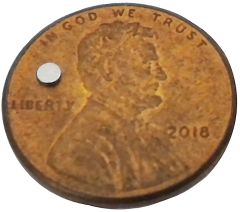
- 100 magnets.
- Pull Force: 0.05 pounds per magnet
- SKU# M2x05MMDI
$6.99 As low as $4.89