
Magnets in Electronics

We use our state-of-the-art cell phones, tablets and televisions on a regular basis, but it’s easy to forget about the parts inside that make them work so well and allows them to be a fixture in our lives. As it turns out, a lot of the electronics we use every day rely on magnets to function at their fullest capability. We’ll show you how.
TELEVISIONS
Older televisions used cathode ray tubes that send a stream of electrons toward the screen. These electrons travel at rapid speed in a straight line and strike the screen at a centralized location. Electromagnets in a deflection yoke around the tube’s neck steer the beam so it sweeps across the entire screen. When the electrons strike, a coating lights up that allows us to see visual images on the screen.
COMPUTERS/VIDEO DISCS
Older CRT computer monitors worked on the same principle as televisions. But it doesn’t end there. The computer discs we insert into computers to store and transport data are usually optical, not magnetic. Optical discs used for computers and gaming consoles such as Xbox or Playstation store data as tiny pits read by a laser, not magnetically. Magnetic media such as floppy disks use a coating of iron oxide to store patterns of tiny magnetic fields. For gaming consoles, these discs store the data that allows the game to load and function.
VIDEOTAPES
We may not use them as much anymore, but videotapes also use a similar coating of iron compounds that paves way for magnetic fields to be stored in patterns on the tape, which allows it to function.
USE APEX MAGNETS TODAY
At Apex Magnets, our stock magnets come in a variety of sizes, shapes and grades that suit many electronic devices. Sort through our entire product line, or jump straight to some of our most popular B2B products, such as magnetic hooks and countersinks. Contact us with questions, and we’ll help you find the best product for your needs.
-
3/8 x 1/8 Inch Neodymium Countersunk Ring Magnet N48 (8 Pack)
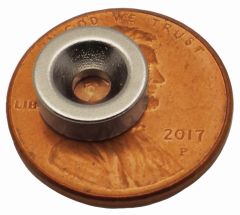
- 3.60 lb pull per magnetpull each
- 8 magnets8 pcs
- SKU M38X18CSR
per pack · $1.12 per magnet$8.99 As low as $6.29 -
1/2 x 1/8 Inch Neodymium Countersunk Ring Magnet N48 (6 Pack)

- 5.50 lb pull per magnetpull each
- 6 magnets6 pcs
- SKU M12X18CSR
per pack · $1.50 per magnet$8.99 As low as $6.29
