
What Is A Magnetic ‘Tractor Beam’?

In the news recently, you may have seen a few companies debut their versions of magnetic hoverboards such as Lexus and Arx Pax. While the hoverboards aren’t quite ready for public consumption, they did pique the interests of NASA scientists. NASA partnered with Arx Pax to use their Hendo Hoverboard engine technology to develop a magnetic ‘tractor beam’. So, what is a ‘tractor beam’ and what does it have to do with the Hendo Hoverboard?
The ‘Tractor Beam’ originated in science fiction. It’s a device used to move objects from a great distance. The name is actually shortened from the original concept called an attractor beam. It was a fictional device developed by the chemist and science fiction writer E.E. Smith. Smith wrote about tractor beams in his 1931 novel Spacehounds of IPC.
Since its conception, the tractor beam has turned up in numerous science fiction novels and movies, including Star Trek. But the tractor beam may no longer be a thing of science fiction as NASA announced a partnership with Arx Pax in 2015 to explore developing one for use in space (the project's current status is not publicly documented). NASA wants to use the tractor beam for the CubeSat project to move small lightweight satellites. Because it relies on eddy currents, the approach works only over short distances and only on conductive targets, unlike the long-range beam of fiction. According to press coverage at the time, the aim was to capture and move tiny satellites without physical contact, using a hover engine.
How Does It Work?
The Hendo Hoverboard uses four disc-shaped electromagnetic engines which create a magnetic field that pushes against a nearby conductive surface. The hoverboard engine generates a strong magnetic field to push against the conductive surfaces of materials like aluminum and copper. This interaction creates a second magnetic field, which is manipulated to either repel or attract.
The magnetic manipulation technology used to create the hoverboard is actually meant to demonstrate the value of magnetic field architecture (MFA). MFA was proposed as a way to protect buildings from natural disasters such as earthquakes by allowing them to hover above the ground. So, other than the magnetic tractor beam and earthquake-proof buildings, what uses for the magnetic hover engine technology can you think of?
Image by Kanijoman
-
Pyrolytic Graphite Magnetic Levitation Kit

- Complete kit to demonstrate diamagnetic levitation.
- Includes (4) 1/2x1/2x1/4 Neodymium block magnets and (1) piece of 1cm x 1cm x 05.mm pyrolytic graphite.
- Pyrolytic graphite is a unique form of graphite produced by decomposition of a hydrocarbon gas, typically methane, at very high temperature in a vacuum furnace, resulting in an ultra-pure product near theoretical density and extremely anisotropic
- SKU# PGMLK
$39.99 -
Magnetic Levitation Pen Science Experiment Kit
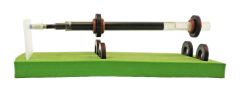
Make your own stable levitating pen with this economical, easy to build levitating pen kit! Make use of the principles of magnetic repulsion to seemingly defy the law of gravity. Great for classroom demonstrations!
$10.99