
Could Magnetism Explain Why Bird Flocks Move as One?
Many people know that birds use the earth’s magnetic field to navigate. It’s called magnetoreception. However, birds’ relationship to magnets might run even deeper as a 2016 study suggests.
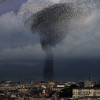
Consider the European starling. It is a small black bird known for its wide range of calls, iridescent feathers, and the massive flocks in which it flies. If you’ve ever seen a flock of starlings in flight, it can be quite a spectacle. Thousands upon thousands of these little birds create what looks like a giant black cloud and, even more impressive, seem to fly as one cohesive unit.
When a group of starlings gather en masse, it’s called a murmuration. Some murmurations can include more than 60,000 individual birds! Watching them fly can be a mesmerizing experience as every bird seems to know the exact movement of its neighbors, leading to the entire flock acting as if it had one mind.
This action is called collective motion and it’s not unique to starlings. Other species of birds like the red-billed quelea (the most abundant wild bird in the world), locusts, schools of fish, and even human cells all display collective movement that forms one unit out of thousands of parts.
The Science Behind It
How exactly this is achieved has always been something of a mystery to scientists, but new findings at Imperial College London suggest the answer might come from a familiar source: magnets, though the researchers used a mathematical analogy rather than a physical magnetic mechanism.
Starling murmurations or human cells are considered active fluid models while magnets fall under the physical models category. Yet, as leading researcher Dr. Chiu Fan Lee explains, physical models might shed some light on how active fluid models function.
Magnetic fields arise from the alignment and motion of electrons, and a magnet is pulled toward materials that respond to that field.
Dr. Lee and his team drew parallels using the Kardar-Parisi-Zhang equation. The KPZ equation was originally developed to describe growing surfaces, such as erosion. The study showed that the ordered phase of incompressible two-dimensional active fluids (such as dense flocks) belongs to the same universality class, which also includes a constrained type of two-dimensional magnet. Dr. Lee suggests that this formula can be applied to active fluid models in the same way it is used with physical models.
The ramifications are many. If this research holds up, it could have numerous impacts of physics, chemistry, molecular biology, and zoology.
-
Pyrolytic Graphite Magnetic Levitation Kit

- Complete kit to demonstrate diamagnetic levitation.
- Includes (4) 1/2x1/2x1/4 Neodymium block magnets and (1) piece of 1cm x 1cm x 05.mm pyrolytic graphite.
- Pyrolytic graphite is a unique form of graphite produced by decomposition of a hydrocarbon gas, typically methane, at very high temperature in a vacuum furnace, resulting in an ultra-pure product near theoretical density and extremely anisotropic
- SKU# PGMLK
$39.99 -
Magnetic Pole Searcher/Finder
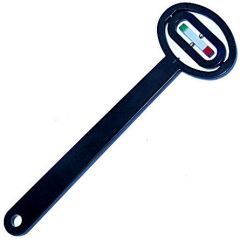
- 1 North/South Pole Magnet Identifier
- The unit consists of a small alnico bar magnet that is gimbal mounted
- SKU# MPS
$10.99 -
Gauss Spectrum Magnetic Field Viewer Film - 8 x 11.75
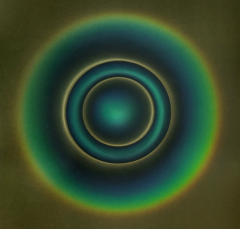
- 1 Piece Gauss Spectrum Magnetic Field Viewer Film
- Display relative gauss strength in a spectrum of color
- SKU# GSVF
$54.99 As low as $46.74