
Why Are British Coins Magnetic?
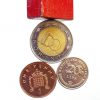
If you’ve ever traveled to the UK, you may have noticed some differences in the currency. Obviously, it looks different and it’s called something else (what we call cents, the British call pence or simply “p”). But there are more contrasts at work. Many British coins are magnetic, while American coins generally aren’t. If you’re like us here at Apex, this is certainly an interesting fact.
To begin, let’s examine what U.S. coins are made out of and rule out why they’re not magnetic. You might think pennies are simply copper and nickels are, well, nickel, but that’s not the case, at least not anymore. Pennies and nickels haven’t been anywhere close to pure metals in quite some time. In fact, most coins are a combination of both copper and nickel. Here’s a quick breakdown:
- Quarter--91.67% Copper, 8.33% Nickel
- Dime--91.67% Copper, 8.33% Nickel
- Nickel--75% Copper, 25% Nickel
- Penny--97.5% Zinc, 2.5% Copper
That’s right! Nickels have about 60 times more copper in them than pennies (while only 25% is actual nickel). Pennies actually cost more to make than they were worth (3.69 cents each in 2024, per the U.S. Mint, which stopped striking them for circulation in November 2025), and many countries have done away with 1 cent pieces altogether! Nonetheless, the alloys in U.S. coins are not noticeably magnetic.
For contrast, let’s take a trip across the pond. In the UK, coins are also deceptively minted, more so than their American cousins. While 1p and 2p coins are thought to be copper like American pennies, they are in fact mostly copper-plated steel. Maybe even worse are the 5p and 10p coins that, though many still think to be silver, are actually nickel-plated steel.
The smaller British coins (1p, 2p, 5p and 10p) are primarily composed of steel. Steel is made using iron, the most ferromagnetic element we know of. Therefore any coin made of steel would be magnetic itself.
So are there any advantages in having magnetic coins? Not really. One might be that the magnetic signature of British coins can be detected by coin-operated machines, thus preventing people from using fakes or slugs. If a coin is not magnetic, vending machines can still ensure coins are real by testing their electrical conductivity, size and weight.
Many other currencies including Canada’s current dollar coins (multi-ply plated steel since 2012) and some of the Euro’s smaller coins are also magnetic, but the bottom line is that there doesn’t seem to be any definitive advantage to magnetic coins other than they make for some pretty nifty magic tricks.
While our currency may not be magnetic, we still have plenty of other magnets to keep us occupied. Be sure to check out our wide range of products, accessories, and even DIYs!
-
1/2 Inch Neodymium Sphere Magnet N48 (4 Pack)
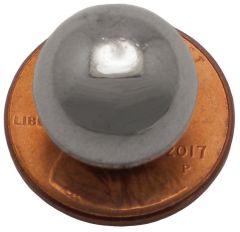
- 4 magnets
- Pull Force: 7.38 pounds per magnet
- SKU# M12SP
 $17.99 As low as $12.59
-
Pyrolytic Graphite Magnetic Levitation Kit

- Complete kit to demonstrate diamagnetic levitation.
- Includes (4) 1/2x1/2x1/4 Neodymium block magnets and (1) piece of 1cm x 1cm x 05.mm pyrolytic graphite.
- Pyrolytic graphite is a unique form of graphite produced by decomposition of a hydrocarbon gas, typically methane, at very high temperature in a vacuum furnace, resulting in an ultra-pure product near theoretical density and extremely anisotropic
- SKU# PGMLK
$39.99