What is the Difference Between "Surface Gauss" and "Manufacturer's Gauss"?

Surface Gauss
Surface gauss refers to the gauss measurement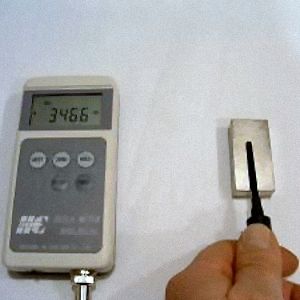 at the surface of a magnet. Magnets can have vastly different strengths between the center of the magnet and its surface. The surface gauss rating is a useful indicator of the field at the magnet's face, but it does not by itself determine how strong a magnet will be in use, since pull force also depends on size, grade, steel thickness and air gap.
Surface readings are taken with a gaussmeter at the magnet's face. Sellers more often list the material's remanence (Br) or grade, since surface readings depend on shape and size.
The field a magnet exerts on nearby objects is closely tied to its surface gauss rating. Some manufacturers are able to provide information about the surface gauss of a magnet when asked.
Manufacturer's gauss
Manufacturer's gauss refers to the remanence (Br) of the magnet material, the flux density the material holds in a closed magnetic circuit. This rating is typically higher than the surface gauss. Surface readings on the same magnet are usually lower because flux spreads out and leaks at the faces. Manufacturer's gauss is also commonly called residual flux density or remanence (Br). The gauss rating quoted by a manufacturer is a material value, not a reading taken at the magnet's core. It is important for buyers to understand the difference in gauss ratings in order to ensure that they purchase a magnet that is strong enough for their needs. While it may appear that the manufacturer's gauss rating is deceptive in nature, the truth is that manufacturers simply use a rating system that strives to represent the magnet material's maximum flux density. When you are in doubt about which gauss rating to use, you should assume that the rating relates to the manufacturer's gauss, and expect a lower reading at the surface. However, getting a magnet for a project is a matter of making sure that the gauss rating is accurate. Buyers can contact the manufacturer or the seller for clarification when the strength of a magnet is particularly important.Discover More With Apex Magnets
Knowing the difference between surface gauss and manufacturer’s gauss is not only useful to know, but it is also useful for determining which magnet to purchase for your next project. If you have any questions about surface gauss and manufacturer’s gauss, don’t hesitate to contact us.
Want to stay up-to-date on the latest magnetic discoveries? Sign up for our newsletter to get these stories and more sent straight to your inbox each month.
Related Products
-
Pyrolytic Graphite Magnetic Levitation Kit

- Complete kit to demonstrate diamagnetic levitation.
- Includes (4) 1/2x1/2x1/4 Neodymium block magnets and (1) piece of 1cm x 1cm x 05.mm pyrolytic graphite.
- Pyrolytic graphite is a unique form of graphite produced by decomposition of a hydrocarbon gas, typically methane, at very high temperature in a vacuum furnace, resulting in an ultra-pure product near theoretical density and extremely anisotropic
- SKU# PGMLK
$39.99 -
12" x 12" Magnetic Field Viewer Film

- 1 Piece Magnetic Field Viewer Film
- The poles appear dark green
- SKU# VF12
$49.99 As low as $42.49 -
1/2 x 1/8 x 1/8 Inch Neodymium Bar Magnet N48 (30 Pack)

- 30 magnets
- Pull Force: 1.34 pounds per magnet
- SKU# M121818BR
 $12.99 As low as $9.09