
magnets in science
-
Magnetism and the Data Storage Crisis
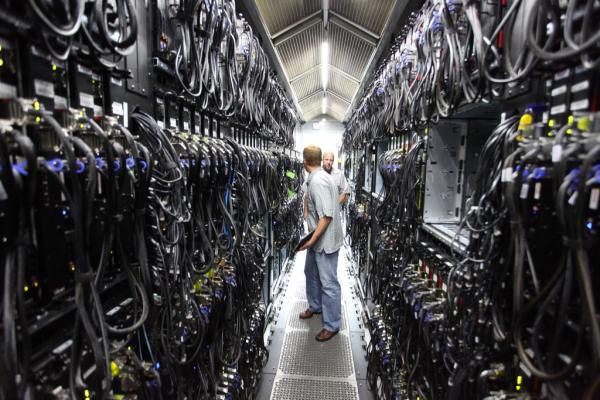 We don’t usually think of data taking up too much space in the grand scheme of things. You might get a message from Google or Apple telling you your storage is almost full, then you are forced to delete all those photos you’ve accumulated over the past few months and your problem is solved (until next time, at least). But what happens when the entire planet receives this notification? Between external hard drives and online storage services like the Cloud, it seems like there is infinite space for all of our photos and documents and music files and the countless other things to which we need access at a moment’s notice. But this is not the case. Continue reading →
-
Magnetic Cyborgs
 When you visit the Grindhouse Wetware website the question, “What would you like to be today?” appears in front of a background of what appears to be an electrical grid or circuit board. The biotechnology company located in Pittsburgh, PA turns its customers into cyborgs, using magnets and other electronic devices. Continue reading →
-
Meet the Magnetic Elevators of the Future
 They say “if it ain't broke, don’t fix it.” And from roughly 1853 untill now, the way elevators rise and descend has changed minimally. In 2003 thyssenkrupp, an industrial business group, developed a twin elevator that changed the amount of traditional cabins used, but not the way they travel. Stacked on top of each other, the elevators acted as two separate cabins that would enhance travel times and energy efficiency. Now, using the power of magnetism, the company is back and making an elevator that will change everything you’ve ever known and seen in elevators. Headquartered in Germany, thyssenkrupp is developing an elevator system called MULTI. The plans for the design will transform the way we think about elevators from only moving up and down to moving left and right as well. Continue reading →
-
Magnetic Propulsion and the Final Frontier
 With help from magnets, we may be able to explore farther and deeper into the final frontier than ever before. This may sound like science fiction, but scientists are already experimenting with electromagnetic propulsion as a possible alternative to chemical launches. So, how does electromagnetic propulsion work? Continue reading →
-
Visualizing Magnetism With MIMI: Magnetospheric Imaging Instruments
 Many of us are aware that plasma is one of the fundamental states of matter. What is not always apparent to us earthlings is that plasma is invisible to the naked eye in certain areas of the universe. But with the help of a tool called MIMI (Magnetospheric Imaging Instrument) NASA can view an entirely new world of material. Continue reading →
-
Electromagnets Could Track Movement In Virtual Reality
 There are many ways you can use magnets nowadays, from hanging pictures on your fridge to charging your phone. These are commonplace uses for magnets, but a more futuristic application is right around the corner. Soon we might be using magnets not to influence the real world, but a virtual one. Continue reading →
-
The Science Behind Ferrofluids
While most rare earth magnets are made from the rock hard materials we’re familiar with, not all appear in that classic solid form. Ferrofluid is a stable colloidal suspension of superparamagnetic iron oxide nanoparticles. So, simply, it is a liquid that contains tiny magnetic particles. It’s magnetic properties comes from the magnetized iron oxide it contains. These particles are known as nanoparticles because of their small size -- the particles are actually so small that they stay suspended under normal conditions! Continue reading → -
How Does the Hyperloop Train Use Magnets?
Recently, there has been a lot of hype about Elon Musk’s Hyperloop train. Musk, who is no stranger to innovation and entrepreneurship, has also founded Tesla Motors, PayPal and SpaceX. The Hyperloop train, a high-speed mode of transportation is his latest venture. The Hyperloop would use a system of tubes and pods to get people from one place to another faster than ever before. According to CNN, it would travel twice as fast as the fastest train in the world, the Maglev. Maglev trains float above a magnetically levitated track. Shanghai's commercial maglev runs at up to 268 mph (431 km/h), and Japan's experimental L0 Series SCMaglev set a rail speed record of 375 mph (603 km/h) in April 2015. In other words, the Hyperloop train could potentially travel at up to 760 mph, according to Musk's 2013 Hyperloop Alpha design paper. How could it travel at such high speeds? Continue reading → -
3 Ground-Breaking Robotics Made Possible With Magnets
When it comes to super powerful magnets, we often think, “the bigger, the better.” However, even though it is usually the enormous magnets that are strong enough to destroy items with their magnetic force, small magnets are powerful in their own ways. For example, small rare earth magnets help to power our phones, TVs and mobile devices. When it comes to robotics and nanotechnology, they are crucial. Continue reading → -
4 of the Greatest Scientific Magnet Developments of 2014
Magnets have been around for hundreds of years. The naturally occurring magnetic stone, lodestone, has been linked as far back as 600 B.C., and magnetic compasses appeared around 4th century B.C. China. Magnets and their uses have greatly evolved since those times, however. Now, magnets are stronger, more versatile and more common━appearing in almost every piece of technology that exists today. Looking back on 2014, we can’t help but remember some of the innovative and interesting magnetic developments that have happened. In honor of this past year, we have compiled a list of the most interesting magnetic developments of 2014. Continue reading →