When we think of items that have helped revolutionize various industries, we may think as far back as the printing press and its impacts on the newspaper industry. Maybe we think of the Internet and its effect on nearly every industry imaginable. But what about magnets? Surely we know magnets are important, but do they still have a breakthrough-worthy impact on revolutionizing industries today?
Here are just a few industries that are using the power of magnets to revolutionize their work. Continue reading →
In what may appear to be no big deal -- but is in fact, a big deal -- 3D printed magnets have been created by using laser beams and metal powder. Empa team, led by Ariyan Arabi-Hashemi and Christian Leinenbach, used a special type of stainless steel to precisely 3D print magnets, with a final result looking like a metal chess board. The board is four millimeters long on each side with alternating darker and lighter spots in the shape of squares. Eight of these squares are magnetic and the other eight have non-magnetic properties. Continue reading →
A team of researchers working at the Advanced Photon Source (APS), a U.S Department of Energy facility Argonne National Laboratory, has been able to show that, by applying slow and steady pressure, some magnetic materials can be pushed into a state similar to a liquid. Continue reading →
While graphene has mechanical, electronic, and optical properties it hasn’t been good for magnetic purposes. Empa researchers and international partners have succeeded in synthesizing nanographene which shows that carbon in very specific forms can have magnetic properties. What We’ve Known Graphene is usually described as a semimetal rather than a true metal, thanks to its 2-D structure made of carbon...
A team of researchers from Purdue have measured torque in a vacuum for the first time in history. By making what was, at the time, the fastest spinning object ever with a laser-like 150-nanometer dumbbell-shaped silica nanoparticle, this team showed how a tiny ball of silicon dioxide that rotates 300 billion times per minute (about 5 billion times per second) has been able to detect torque, for the first time ever. Continue reading →
A group of researchers led by MIT Department of Physics Professor Pablo Jarillo-Herrero have built on prior research to present us with new findings. Previous research led by researchers at MIT showed that rotating layers of hexagonally-structured graphene at a particular “magic angle” could change the material’s electronic properties from an insulating state to a superconducting state. This time, Jarillo-Herro’s group went deep into 2-D magnets to find if magnetism in certain materials is different in atomically thin layers than in their bulk forms. Continue reading →
Magnetic materials may play a role in collecting energy from heat. Heat applied across a magnetic material can drive a flow of magnetic spin, which can generate an electrical voltage. Once paramagnets are heated up, though, nothing happens. That is until an international team of researchers and scientists found a way to capture heat and transform it into electricity using paramagnets, something that wasn’t thought to be possible. Continue reading →
On September 5th, St. Jude Children’s Research Hospital, located in Memphis, TN, received the most powerful nuclear magnetic resonance (NMR) magnet in the world. You may be asking, ”what would a hospital need a 10-ton magnet that’s hundreds of thousands of times stronger than the earth’s magnetic field for?” Below, you’ll find your answer. Continue reading →
Grip firmness is an important trait of human hands—we have the capability to handle something delicate, such as an egg, but we’re also able to hold a baseball bat with enough strength to hit a baseball and send it flying. Scientists have now found a way to make a robotic hand share this same characteristic. Continue reading →
Normally, it’s possible for light to transform the properties of a material; however, these properties must exist to be manipulated. Physicists now believe they have found a way to use lasers to transform the properties of a material, creating new properties. Specifically, their theoretical work suggests a way to make non-magnetic materials magnetic. Continue reading →

 When we think of items that have helped revolutionize various industries, we may think as far back as the printing press and its impacts on the newspaper industry. Maybe we think of the Internet and its effect on nearly every industry imaginable. But what about magnets? Surely we know magnets are important, but do they still have a breakthrough-worthy impact on revolutionizing industries today? Here are just a few industries that are using the power of magnets to revolutionize their work. Continue reading →
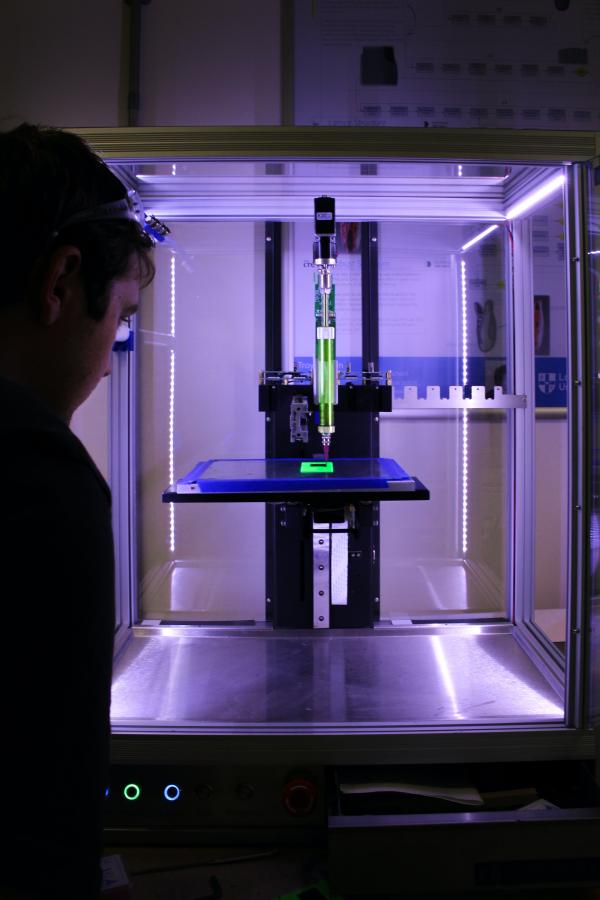 In what may appear to be no big deal -- but is in fact, a big deal -- 3D printed magnets have been created by using laser beams and metal powder. Empa team, led by Ariyan Arabi-Hashemi and Christian Leinenbach, used a special type of stainless steel to precisely 3D print magnets, with a final result looking like a metal chess board. The board is four millimeters long on each side with alternating darker and lighter spots in the shape of squares. Eight of these squares are magnetic and the other eight have non-magnetic properties. Continue reading →
 A team of researchers working at the Advanced Photon Source (APS), a U.S Department of Energy facility Argonne National Laboratory, has been able to show that, by applying slow and steady pressure, some magnetic materials can be pushed into a state similar to a liquid. Continue reading →
 While graphene has mechanical, electronic, and optical properties it hasn’t been good for magnetic purposes. Empa researchers and international partners have succeeded in synthesizing nanographene which shows that carbon in very specific forms can have magnetic properties. What We’ve Known Graphene is usually described as a semimetal rather than a true metal, thanks to its 2-D structure made of carbon...
 A team of researchers from Purdue have measured torque in a vacuum for the first time in history. By making what was, at the time, the fastest spinning object ever with a laser-like 150-nanometer dumbbell-shaped silica nanoparticle, this team showed how a tiny ball of silicon dioxide that rotates 300 billion times per minute (about 5 billion times per second) has been able to detect torque, for the first time ever. Continue reading →
 A group of researchers led by MIT Department of Physics Professor Pablo Jarillo-Herrero have built on prior research to present us with new findings. Previous research led by researchers at MIT showed that rotating layers of hexagonally-structured graphene at a particular “magic angle” could change the material’s electronic properties from an insulating state to a superconducting state. This time, Jarillo-Herro’s group went deep into 2-D magnets to find if magnetism in certain materials is different in atomically thin layers than in their bulk forms. Continue reading →