Search results for 'nasa'
-
The Magnetic Field of the Sun
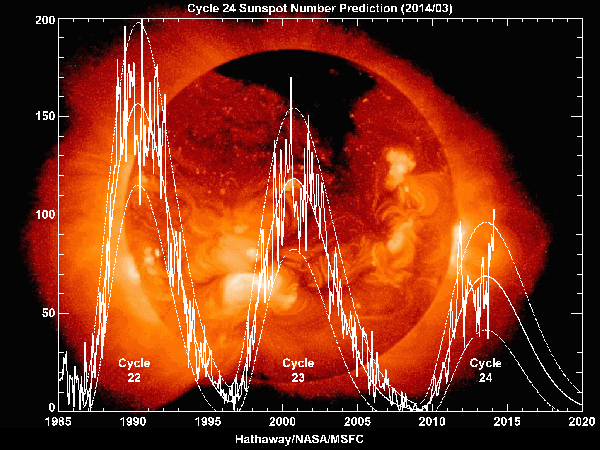 The magnetic field of the sun plays a huge role in our galaxy. The sun’s surface is more than 12,000 times larger than Earth’s, and its magnetic field extends even beyond Pluto. It has two poles like a bar magnet, and like most stars, the convection of plasma generates its magnetic field. Compared to the magnetic fields of the other planets in our solar system, however, the sun’s magnetic activity is more extensive including solar flares, sunspots, space weather, and pole reversal. Continue reading →
-
The Magnetic Fields of Our Solar System
 Magnetic fields protect planets and atmospheres from solar particles. The particles from the sun are charged, which means they respond to the magnetic field and move around it. Magnetic fields are generated by the movement of electrically conducting fluid inside the planet, usually in or around the core. Earth’s magnetic field is generated by liquid metal at the core and Earth’s rotation of 24 hours, combined with heat-driven convection of the liquid, produces the movement that sustains a magnetic field. The other planets in our solar system, except for Venus and Mars, all have magnetic fields or traces of magnetism that differ from Earth’s in various ways. So, how are other planetary magnetic fields generated? Continue reading →
-
How Magnetic Levitation Could Help Astronauts Reach Mars
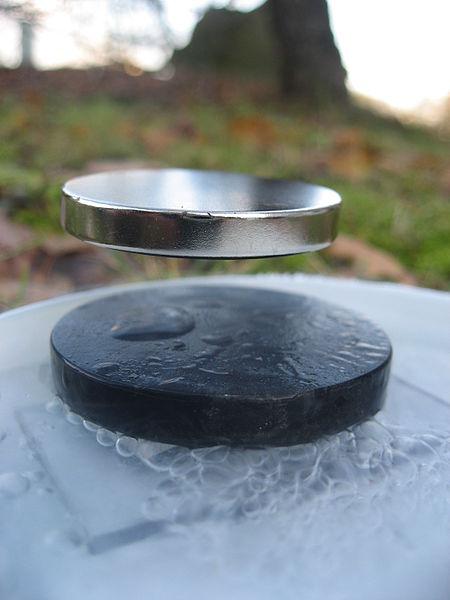
 Levitating frogs and flies might seem like something out of a Harry Potter movie, but researchers believe that they can use magnetic levitation on flies to study the long term effects of weightlessness on humans. Continue reading →
-
The Most Powerful Magnets In The Universe: Magnetars
 Do you know that the most powerful magnets in the universe are actually a type of star. Magnetars are the remains of stars that have “run out of fuel”, meaning the hydrogen in their cores has been used up. The star is essentially dying, and when this happens, it tries to compensate for the lack of fuel by fusing progressively heavier elements. This smorgasbord of fuels causes the star to burn as a bright red giant, but only for a temporary time. Eventually, the burning causes the star to burst into a supernova explosion. Continue reading →
-
What is the Magnetosphere?
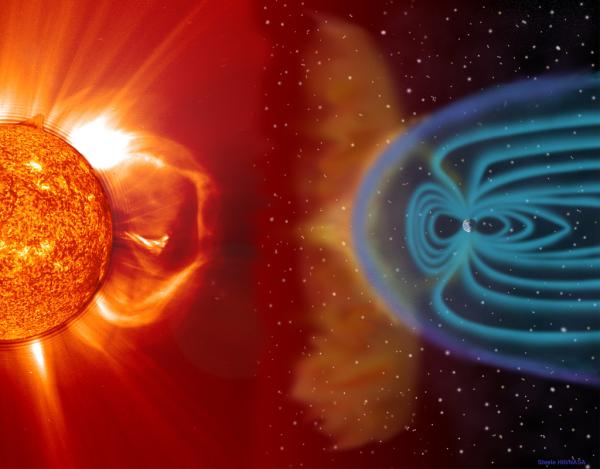
 Planets that have magnetic fields also have a magnetosphere. Venus and Mars are the only planets without a global magnetic field. NASA’s MAVEN mission has shown that Mars lost its global field early in its history and that the solar wind then stripped away its atmosphere, which scientists think helped Mars lose its surface water. Whether a missing field also explains Venus’s dry surface is still debated. The Earth’s magnetic field protects us from the charged particles of the solar wind. Without this protection, solar wind particles could strip away parts of the atmosphere and increase radiation at the surface. Continue reading →
-
The First Discovery of Magnetism: Lodestone
 If you are a magnet enthusiast or geology buff, you may have heard of a magnetic stone known as lodestone. The properties and origins of this magnetic material make it quite an interesting study. Lodestone has been linked as far back as 600 BC and is often cited in history as the first indication of magnetism, leading to further magnetic discoveries like the early compass in China. Continue reading →
-
Magnet Experiments: Iron Filings and Neodymium Magnets
Iron filings are, as their name suggests, filed pieces of iron that look like a metallic powder. Their properties are, in some aspects, similar to ferrofluid, because they form a significant pattern when interacting with a magnet. Magnetic fields are invisible, but the pattern that both substances form represents the lines of a magnetic field. Pairing iron filings and magnets together is probably one of the most common, preliminary experiments used to show magnetism. Despite its commonality it is still an interesting way to display the magnetic field. Conduct your own experiment with iron filings and these simple steps! Continue reading → -
What the Weakening of Earth’s Magnetic Fields Actually Means
Scientists have known that the Earth’s magnetic poles are going to flip for a while. In fact, the poles have shifted many times before, but this time it is happening more rapidly. New data magnetic maps from Swarm, a trio of satellites controlled by the European Space Agency (ESA) reveals that, as of 2014, the field was weakening at about 5 percent per decade, which press reports described as 10 times faster than first thought (NASA notes the field has weakened about 9 percent over the past 200 years). The thought of the planet’s poles flipping sounds pretty scary, but what does it actually mean? Continue reading → -
May the Fourth be with You: The “Force” of Magnets
Every geek, science lover, movie enthusiast, and anyone not living under a rock knows that Star Wars Day is May the Fourth! Even if you don’t believe in Lucas’ mystical ‘force’, there is a very real invisible force that we encounter everyday-Earth’s magnetic force. Like the power of the Jedi and Sith, magnetic fields are invisible and magnets possess an invisible but nevertheless powerful force. Magnetism is so powerful that it protects us by deflecting charged particles from the solar wind and cosmic rays before they reach the Earth’s surface. It is also responsible for many cool scientific phenomenons. In honor of May the Fourth, we have compiled four of our favorite examples of the magnetic force in action. Continue reading → -
Ferrofluid: Overview and Experiment
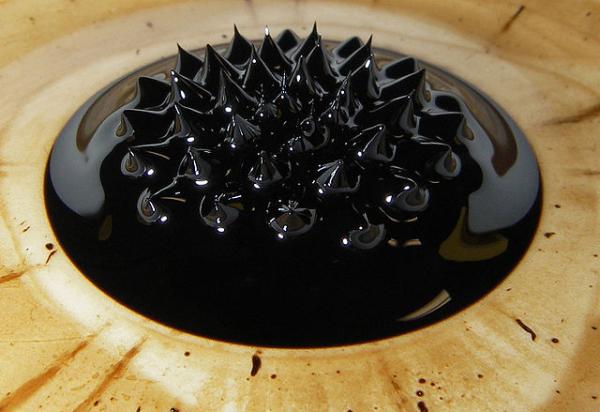
NASA first developed ferrofluid while experimenting with different methods to control liquid in zero-gravity space conditions. Since it was developed, ferrofluid is now used in a number of practical applications like: Improving the sound quality in speakers. Protecting computer disk drives. Forming seals in industrial equipment, such as rotary shaft seals. Continue reading →