Magnet Science, Research & History
-
Reprogrammable Magnetic Cilia & Soft Robotics
 Magnetic cilia, tiny artificial hairs powered by embedded magnetic particles, have long been used in applications like soft robotics, object transport, and liquid mixing. Now, researchers at North Carolina State University have developed reprogrammable magnetic cilia that can change their behavior at room temperature, opening new possibilities for adaptable, multi-purpose designs. What Makes These Cilia Unique? Traditional magnetic cilia use...
-
Can Coal Mines Become Dual-resource Operations
Interestingly, rare earth elements (REEs) are being found in unexpected places, like coal-adjacent formations in Utah and Colorado. A recent study by the University of Utah reveals elevated REE concentrations in fine-grain shale and siltstone layers near coal seams in active mines along the Uinta coal belt. These findings open the door for existing coal mines to become dual-resource operations... -
Neodymium’s role in Energy Transition
 As the world transitions to cleaner energy, one rare element has become critical for electrification: neodymium. While it may not have the name recognition of lithium or platinum, neodymium is essential in powering technologies like electric vehicles (EVs) and wind turbines. With increasing global demand for these technologies, the question is quickly becoming: can the supply of neodymium be scaled...
-
Advancements in Magnet Molecules: A Leap Toward Simplified Optical Data Reading
 Magnet molecules—magnets made up of single molecules—offer incredible potential for nanometric-scale information storage and quantum technologies. These molecules retain a "memory" of the magnetic field they experience, making them prime candidates for applications like quantum computing and high-density data storage. However, reading this magnetic information has historically required complex techniques involving polarized light, limiting its practical use. A breakthrough has...
-
Magnets at the Heart of High-Luminosity Particle Collisions
 The High-Luminosity Large Hadron Collider (HL-LHC), an upgrade to the LHC, is set to revolutionize particle physics, thanks to cutting-edge magnets like the Inner Triplet (IT) series. These magnets, key to directing and focusing particle beams, are undergoing rigorous testing at CERN's IT String facility, a full-scale replica of the HL-LHC's operational sections near the ATLAS and CMS experiments. Powerful...
-
Magnets Paving the Way for Homegrown Energy Independence
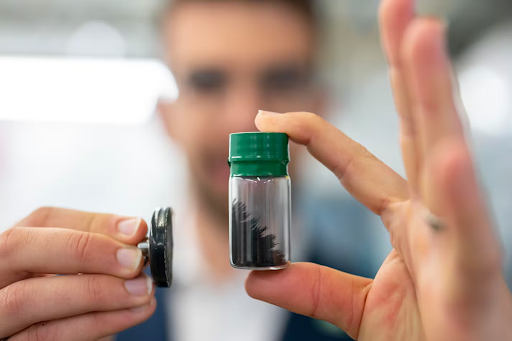 On October 10, 2024, Niron Magnetics opened its first plant, a commercial pilot plant in Minneapolis, marking a significant advancement in U.S.-based magnet production. At the event, a local musician’s electric guitar rendition of “The Star-Spangled Banner” highlighted the technology in action: the guitar’s pickups contained magnets made of iron and nitrogen, a material originally developed in the University of Minnesota laboratories. Continue reading →
-
Magnetic Discovery Driving Change in Quantum Computing
 A groundbreaking study from Rice University physicists and international collaborators is reshaping how scientists understand magnetism and electronic behavior in cutting-edge materials—a discovery that could drive advancements in quantum computing and high-temperature superconductors. Led by Rice researchers Zheng Ren and Ming Yi, the team explored thin films of iron-tin (FeSn), finding that this material's magnetic properties come from localized electrons, not the previously assumed mobile electrons. Continue reading →
-
New Rare Earth Facility on Pace to Open in India
Over the past year, we have examined the growing number of rare earth plants popping up across the globe. From Europe to the continental United States, industry experts are investing in a more economically sound future and a lesser dependence on China. Now, a new facility may be opening in India to help its rare earth push. Continue reading → -
U.S. Government Issues $456 Million Loan to Rare Earth Project
The United States continues to evaluate how it can produce rare earths domestically, and one of the most promising developments has now received backing from the nation’s government. Wyoming Rare, a wholly owned subsidiary of American Rare Earths Limited, just received a non-binding letter of interest from the Export-Import Bank of the United States (EXIM) totaling $456 Million. While the loan will be a great help for Wyoming Rare’s “Halleck Creek Project”, it is not binding. This means the project will need to progress accordingly for the company to receive the influx of cash. Continue reading → -
Electron Energy Corp. Joins Forces with Magnetic Holdings to Accelerate Growth in Rare Earth Magnet Industry
In a strategic move that promises to enhance its growth and strengthen its position in the rare-earth magnet industry, Landisville-based Electron Energy Corp. has partnered with Magnetic Holdings LLC. It’s a huge milestone in its storied history. This partnership not only brings together two powerhouse companies in the magnet industry but also signals a new chapter for Electron Energy, the only remaining U.S. producer of samarium cobalt magnets. Continue reading → -
The Future of Computing & Harnessing Atomic-Scale 2D Magnets
In the world of technology, innovation reigns supreme. The demand for faster, more efficient, and compact devices has driven researchers to explore the frontiers of materials science. A groundbreaking development in atomic-scale 2D magnets has the potential to revolutionize computing as we know it. This innovation could lead to unprecedented miniaturization and energy efficiency in computing components, opening up all sorts of new possibilities. Continue reading → -
Belgian Group to Supply Europe with Rare Earth Metals
Over the past couple of years, new rare earth plants and initiatives have sprung up as nations across the world look to shift from their dependence on China. Just a few weeks ago, we covered the story of Europe’s first dedicated rare earth facility. Now, another facility is joining the mix to help with the efforts. Continue reading → -
A Revolution in Fusion Power
The fusion energy industry is on the brink of a revolution, driven by groundbreaking magnet designs that aim to make fusion power a practical reality. Two key players in this field, Commonwealth Fusion Systems (CFS) and Realta, are leveraging powerful magnetic fields to contain and control plasma, the core component of fusion reactions. Continue reading → -
Landmark Rare Earth Discovery
Recently, we have documented changes in the rare earth industry to decrease the global dependency on China. Earlier in the year, we shared that Nissan was even working on its own magnet to do everything in-house and plans for new facilities in North America. This week, we are going across the pond to take a closer look at a landmark rare earth discovery in Europe. Join us as we evaluate what this welcome discovery could mean for consumers and the global supply. Continue reading → -
Ara Partners’ Strategic Acquisition of Vacuumschmelze (VAC): A Decarbonization Power Play
In 2023, in a significant move to advance the decarbonization of transportation in North America, Ara Partners acquired Vacuumschmelze (VAC) from Apollo Global Management. This strategic acquisition underscores Ara Partners' commitment to sustainable solutions, particularly in the burgeoning electric vehicle (EV) market. Continue reading → -
Magnets Power the Modern World
Magnetism has intrigued humanity since ancient times. Thales of Miletus (c. 624–546 BC) observed iron's peculiar attraction to a substance now known as lodestone, or magnetite. This naturally occurring magnet, composed of iron oxide (Fe3O4), was discovered in Magnesia, Asia Minor. Early Chinese innovations revealed that a suspended piece of magnetite consistently aligned in a north-south direction, laying the groundwork for the magnetic compass. This fundamental understanding of magnetism eventually evolved into harnessing magnetic forces to generate electrical energy, forming the backbone of modern electricity production. Continue reading → -
MIT’s PSFC Achieves Fusion Milestone with Record-Breaking Superconducting Magnet
On September 5, 2021, researchers at MIT’s Plasma Science and Fusion Center (PSFC) reached a milestone in fusion energy research. They successfully tested a groundbreaking high-temperature superconducting magnet, achieving a record magnetic field strength of 20 tesla. This feat is a crucial step toward creating practical fusion power plants, potentially revolutionizing the future of energy with virtually limitless and clean power. Continue reading → -
Altermagnetism: The Emergence of a New Magnetic Phase
For nearly a century, scientists have understood ferromagnetism and antiferromagnetism as the two primary classes of magnetic order in materials. Ferromagnets, like those found on refrigerator doors, have all their magnetic moments aligned in the same direction, creating a strong external magnetic field. Antiferromagnets, on the other hand, feature alternating magnetic moments that cancel each other out, resulting in no macroscopic magnetic effect. Continue reading → -
The Great Magnetic Race: Invention of Neodymium-Iron-Boron Permanent Magnet
In the early 1980s, the world witnessed a magnetic revolution that transformed industries ranging from automotive to renewable energy. At the heart of this revolution was the invention of neodymium-iron-boron (NdFeB) permanent magnets, a breakthrough that emerged from a cloak of corporate secrecy and competitive fervor. Continue reading → -
Rare Earth Renaissance: How the U.S., Australia, and Canada Lead the Charge
From LEDs to electric vehicles and military applications, rare earth elements are the backbone of some of the most critical and fastest-growing industries worldwide. However, overreliance on China for roughly 85-90% of refined rare earths (International Energy Agency estimates for 2024-2025) has sparked concerns in Western nations, prompting a strategic shift towards reclaiming control over the supply chain. Continue reading → -
Magnetic Discovery: Rare-earths Aging to Become Water Repellent
In a study published in Scientific Reports, researchers from the University of Basel, the Swiss Nanoscience Institute, and the Paul Scherrer Institute shed light on a fascinating phenomenon: surfaces coated with rare earth oxides gain water-repelling characteristics upon exposure to air. These surfaces show this trait even at room temperature, owing to chemical reactions initiated by ambient hydrocarbons. Continue reading → -
Magnetic Design & Distribution In Europe: Prodin Leading the Pack
The story of magnetic design and distribution in Europe is layered. For example, Prodin, headquartered in Barcelona, Spain, has been at the forefront of magnetic distribution in Europe since its inception. Founded by Josep Llano, Prodin has weathered storms, adapted to changing market dynamics, and emerged as a leader in the field of magnetics. Continue reading → -
Magnetic Breakthrough in Green Hydrogen Production
In the pursuit of sustainable energy solutions, efficient hydrogen production has reached a milestone. Researchers at the University of Twente have unveiled a groundbreaking approach that enhances the efficiency of the oxygen-producing half of water electrolysis, a step in hydrogen production, through the manipulation of magnetic properties within catalyst materials. This breakthrough not only promises a more sustainable future but also opens up new avenues for large-scale hydrogen production. Continue reading → -
New Magnetic Study with Quantum Implications
Background of Ferromagnetic Material & Magnetic Spin First, let’s talk about ferromagnetic materials! When you break them down, ferromagnetic materials are made of atoms, which are made of electrons. These electrons act like tiny magnets in and of themselves. Typically, the orientations of these “magnets” are aligned within each region; however, each region is not aligned. When a magnetic field is introduced, the magnetic spins (orientations) in the separate regions line up. This is how the material becomes fully magnetized. Continue reading →