Magnet Science, Research & History
-
Common Magnet Myths
 At Apex Magnets, we hear our fair share of questions about magnets, including inquiries about their make, properties, capabilities, and effects. Many of the questions are about the validity of certain claims, so we decided to put together a blog post about five common magnet myths and why they aren’t true. Continue reading →
-
Lasers Are Affecting Magnets’ Magnetic Properties
 Did you know oftentimes, magnets are not actually magnetic when they are in the early stages of production? Instead, they are activated with a magnetizer (check out our video here to watch this process). If magnets can become magnetized, it shouldn’t come as a surprise, then, that magnets can just as easily become demagnetized. We already know that magnets can become demagnetized for a lot of reasons, such as volume loss from corrosion, high heat, heavy impact, or just over time. Scientists at CU Boulder investigated a new way that magnets are becoming demagnetized though -- being shot by a laser. Continue reading →
-
How the Moon Got "Sunburns" - Solar Wind and Magnetic Fields
 As we all know, the Sun is powerful. So powerful that any object, person, or planet traveling through space is susceptible to the Sun’s damaging radiation. The latest victim to feel the Sun’s fiery wrath? Earth’s Moon. Researchers, using data from NASA’s ARTEMIS mission, have reported finding “distinctive patterns of darker and lighter swirls” on the Moon’s surface. When looking into it further, they have found that these swirls may actually be “sunburns.” Should we be worried about these sunburns on Earth? Continue reading →
-
How Scientists Can Use “Greener” Methods to Extract Rare-Earth Metals for Your Smartphone
 Almost all technological products we use daily contain rare-earth metals, from computers and screens to networks, MRIs, batteries, magnets, automobiles, and various types of special optical glasses. They’re also used as a catalyst for oil refining. Because so many rare-earth metals are used in these products, they are often called “technology metals.” A generic smartphone uses several rare-earth metals alone...
-
People Can Sense Earth’s Magnetic Field
 A new study, published online in eNeuro, suggests that by studying brain waves, humans may have magnetoreception abilities. This “sixth sense” was previously only known to occur in certain animal species, such as birds and fish, who use the magnetism for navigation. What is Magnetoreception? While it sounds complicated, magnetoreception is, at its fundamental level, the perception of a geomagnetic field...
-
Incredible Uses of Magnets in Science
 We are constantly learning about the capabilities of and research on the uses of magnets, magnetic force, and magnetic fields. From helping moths establish a migration pattern to keeping astronauts safe during interplanetary flights, magnet science is nothing short of impressive. Read more about what magnetic knowledge we gained in 2018 in technology, in space, and in the environment. Magnets...
-
A “Weird” Magnet Shouldn’t Exist, But It Does
After being theorized for decades, a material known as USb2 — a uranium and antimony compound—was found to be magnetic despite its singlet-based properties. Its magnetism has also been experimentally proven to exist in reasonable temperatures compared to the extremely cold temperatures it was once tested in. What’s significant about this? This new magnetic material may change the game in information storage for computers based on its potential to transition more easily between magnetized and non-magnetized states. Weird. Continue reading → -
Researchers Find Potential Source of Rare Earth Elements
Since China mines roughly 70 percent of the world's rare earth elements and refines roughly 90 percent of them—but sets limitations and regulations on exporting—researchers are trying to get creative with how to recycle and repurpose rare earth magnets. According to a 2019 study published in the Journal of Chemical Thermodynamics, researchers at Rutgers University-New Brunswick and members of the Critical Materials Institute have found a potential new source of rare earth elements (REE)—phosphorite waste. This discovery could help decrease the cost of REEs and make them more accessible to those outside of China. Continue reading → -
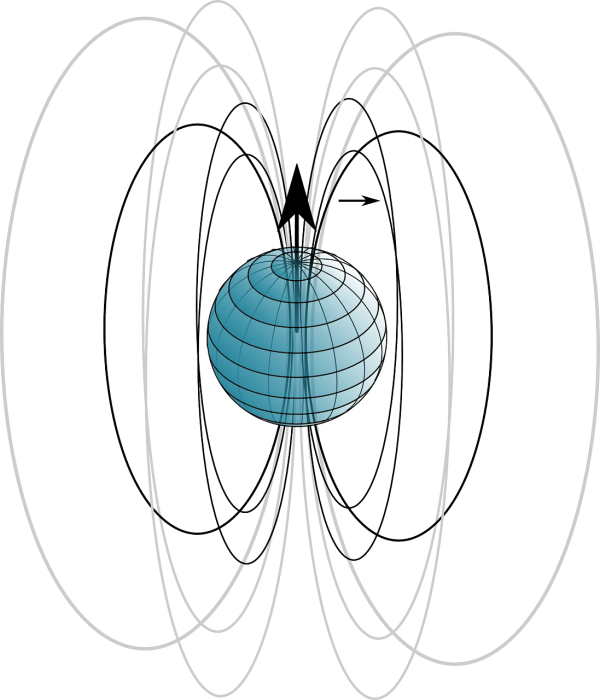
Is Earth’s Magnetic Field Flipping?
According to Nature, Earth’s north magnetic pole is moving so quickly that the World Magnetic Model (WMM) needed to be updated only four years after its latest update. Even though the 2015 update to the model was expected to remain valid until 2020, it’s close to exceeding the acceptable limit for navigational errors. so, updates were made and released in February 2019. Periodically, the north and south poles move so much that they trade locations, which is known as a magnetic field flip.Reversals are irregular, and the last full one was about 780,000 years ago. This phenomenon most likely should not occur for thousands of years, however. But, the fact that WMM needed to be updated so quickly has us questioning what is it that causes the poles to shift, and what this means for Earth’s magnetic field. Below, we outline what all plays into the changes. Continue reading → -
New Discoveries on The Cause of Auroras
The Aurora Borealis and Aurora Australis, better known as the Northern and Southern Lights have always been a topic of discussion. After all, how does this magical explosion of colors light up the sky? We’ve looked into the answer before and found magnetic reconnection was a possible explanation. Continue reading → -
How a Puzzle for Children Helped Physicists Understand Magnetism
At some point during your childhood, you probably played with a popular sliding puzzle game that became a craze in the 1880s consisting of tiles in a grid—most likely a 3x3 grid (an 8-puzzle) or 4x4 grid (a 15-puzzle). The concept was simple: get the tiles in numerical order by sliding the tiles, utilizing the empty space. It was frustrating. It was addicting. It was challenging. Now, physicists are using it as a way to try and understand how magnets work, which is one of the most complex puzzles. Continue reading → -
Black Holes and Their Coronal Magnetic Field
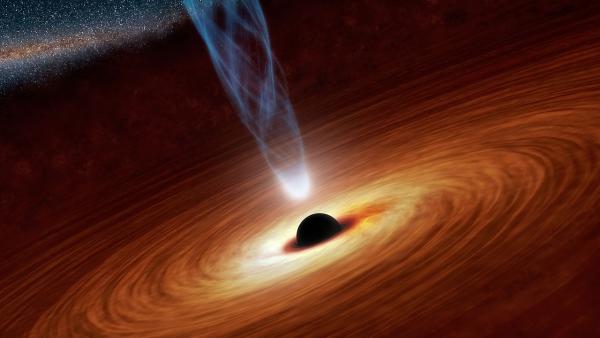
Did you know that supermassive black holes are the largest type of black hole known to mankind? In fact, they contain a mass that is roughly a million to billions of times more massive than typical stellar black holes. It is believed that the supermassive black holes that lurk at the center of most galaxies are surrounded by coronas, but not much is known about why this occurs or even what coronas look like. Continue reading → -
The Zircon Crystal Magnetic Theory is Literally Filled with Holes
A team of researchers led by the University of Cambridge, with collaborators at other institutions including MIT and the University of California, made a discovery that disputes the previous use of zircon crystals as evidence of Earth’s magnetic field’s early development. Their paper, published in Proceedings of the National Academy of Sciences, describes the testing they conducted and the new discoveries they made about the magnetism of zircon crystal. Continue reading → -
Magnetic Field Causes Metamaterial to Stiffen
A new synthetic material has been shown to have interchangeable stiffness when exposed to a magnetic field. This metamaterial—an artificial structure comprised of a grid-like network of plastic tubes filled with fluid that becomes more viscous in a magnetic field—causes the tubes to firm up in a magnetic field, allowing the tube to turn from soft to rigid in a split second. Continue reading → -
A World First: Wind Turbine Upgraded
For the first time in energy industry history, high-temperature superconductors –– rather than permanent magnets –– were used in a full-size wind turbine generator, in the EcoSwing demonstration in Denmark. Continue reading → -
How Are Permanent Magnets Being Used To Make A Revolutionary Energy Accelerator?
Brookhaven National Laboratory (BNL) is dedicated to answering basic and applied science questions that range “from the birth of our universe to the sustainable energy technology of tomorrow.” In 2018, they announced the construction of a test accelerator they call CBETA, the Cornell-Brookhaven ERL Test Accelerator, at Cornell University. The CBETA will reportedly recycle energy by intertwining particle beams through chains of multi-pass permanent magnets in a Halbach array, which augments the magnetic field on one side and cancels the opposite field to near zero. This would revolutionize accelerator science, helping to reduce both cost and size, and fusing the best traits of linear and circular accelerators. Continue reading → -
Magnetic Field Diode
The future of electronics may change, as researchers have created a device that acts as a magnetic diode. This “magnetic field diode” is similar to the already known electrical diode, but this device could transfer a magnetic field to another object, but not the other way around. Continue reading → -
Jupiter's Moon's Magnetic Field
In December 1996, Dr. Margaret Kivelson, professor emerita of space physics at the University of California, Los Angeles, and her team of physicists discovered, using data from NASA’s Galileo spacecraft, that Europa—one of Jupiter’s moons—had a magnetic field induced by Jupiter’s changing field. Flash forward to today where Dr. Kivelson is now the science team leader for the magnetometer instrument on the Europa Clipper mission. This spacecraft, which launched on October 14, 2024 and is due to reach Jupiter in April 2030, will study the habitability of Europa, Jupiter’s “ocean moon.” Continue reading → -
Magnets: A Faster, Cheaper Path to Fusion Energy
A few years in the making, a breakthrough effort towards fusion energy has scientists using powerful magnets to build what is designed to become the world’s first energy-producing fusion experiment. In 2018, a report released by the American Physical Society, revealed that collaborating scientists from the Massachusetts Institute of Technology's Plasma Science & Fusion Center and Commonwealth Fusion Systems were working to speed up the development of fusion energy that can help fight the harmful effects of climate change by using high-powered temperature superconducting magnets. Continue reading → -
Microbots Made from Mushroom Spores Could Clean Polluted Water
Heavy and toxic metals, including lead, can cause serious health problems such as reduced growth and development, cancer, organ damage, or nervous system damage if they leak into our water. In fact, lead exposure, including through water, is linked to a large number of deaths each year. Luckily, scientists at the Advanced Nanomaterials and Microrobotics Laboratory (ANML), a part of The Chinese University of Hong Kong, recently discovered that iron-oxide coated microbots made from mushroom spores could help in removing these heavy metals from contaminated water. Similar to a robot but on a much smaller scale, a microrobot is a miniaturized machine designed to perform a specific task or tasks repeatedly and with precision. Continue reading → -
Single-Atom Magnet Produced at a Record-High Temperature
In the past, we’ve discussed the miraculous new discovery of the single-atom magnet. This single-atom magnet is capable of containing one bit of memory. (Prior to this, the smallest individually addressable magnetic bits on surfaces were made of about 5 to 12 atoms.) This was a huge step forward for data storage! Now, scientists have designed and synthesized a high-temperature single-molecule magnet - the first of its kind! A breakthrough like this could even revolutionize the digital storage capabilities of quantum computers. Is this the ultimate limit in high-density data storage? Continue reading → -
Magnets Protect Astronauts from Solar Wind
A few years ago, we explored this question about how magnets could potentially protect astronauts: can magnets protect against cosmic radiation? Now, a program between the Information Satellite Systems (ISS)-Reshetnev Company and the Siberian Branch of the Russian Academy of Sciences is conducting research on how a magnetic dipole could protect crew members from galactic and solar cosmic rays while on missions beyond Earth’s boundaries that last more than twelve months. Continue reading → -
Magnetic Levitation is the Force Behind the Lexus SLIDE Hoverboard
Thanks to science fiction novels and movies like Back to the Future Part II, hoverboards have long been a symbol for some distant and unknowable future. However, according to Wired, working hoverboard prototypes already exist, and the Lexus SLIDE is one of them. Continue reading → -
Getting Sky High with Super-Conducting Magnets
Chances are you’ve been on a plane to travel to a work conference, vacation, or holiday event. It’s quick, relatively easy, and has the potential for less stress during travel (think about it--there’s no road rage in the sky)! But do you know the environmental impact of flying? When jet fuel is burned, carbon bonds with oxygen and forms carbon dioxide. Carbon dioxide from all sources, not just flying, makes up roughly 80 percent of the greenhouse gases emitted in the United States Continue reading →