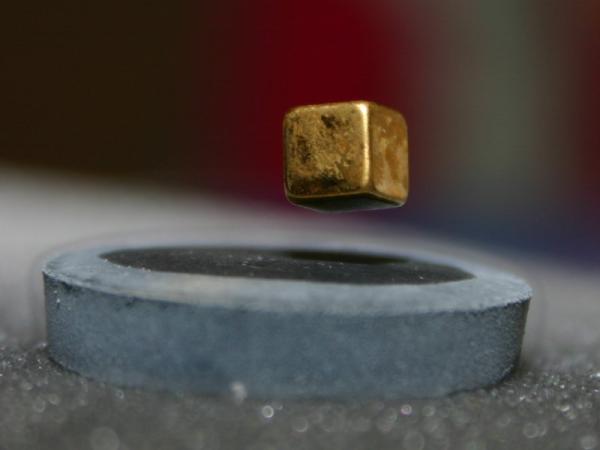
Magnet Science, Research & History
-
4 Fun Facts about Magnets and Sharks
 With summer in full swing, you probably have a few beach trips planned. Whether you’re a swimmer, surfer, or snorkeler, the threat of sharks may have crossed your mind at some point while exploring the ocean. Most of the time sharks are not nearly as bloodthirsty as the monster from Jaws, but if you’re worried, here are a few fun facts about sharks and magnets to keep in mind: Continue reading →
-
The Etymology of Magnets
 We often take the everyday words we use for granted. Where do they come from? How were they formed? When was the first time they were used? These are questions the study of etymology strives to answer. The subject of this blog post is the etymology of the word “magnet” and its derivations (magnetism, magnetize, magnetization). Continue reading →
-
Rock n'Roll: Brought to You By Magnets
 Part 1 - Guitar Pickups If you play electric guitar or bass, chances are you already know what pickups are. It’s also likely that you have some pretty strong opinions on them. For those of you who don’t play, pickups are the devices that essentially make an electric guitar, well, electric. Pickups are super sensitive magnets installed in the body of the guitar and wrapped in copper wire. Continue reading →
-
Do Humans Have Built-In GPS?
 Most of us know at least one way to tell direction. Whether it’s tracking the sun’s position in the sky, locating the North Star at night, or maybe even noting what side of the tree moss is growing on. Maybe you still know how to use a compass. With the advent of GPS systems and apps, it seems like people are less and less able to tell where they’re going without the aid of technology. But what if your phone were dead and you were left without a compass? What if it’s too cloudy to see the sun or stars and there are no trees around? Could you tell which way you were heading? According to some scientists, you might be able to. Some researchers have proposed that human beings may be able to detect magnetic fields given off by the earth and other sources, but this is not established. Continue reading →
-
The Van Allen Radiation Belts
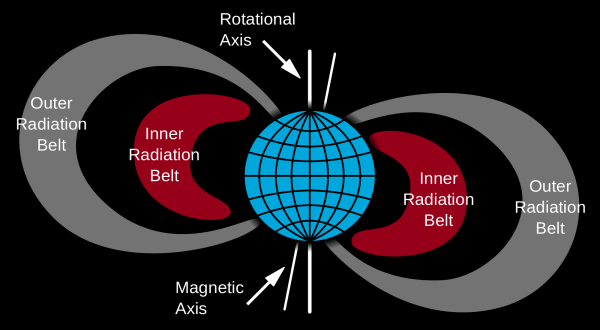 Earth’s magnetic field protects the surface from cosmic radiation and charged particles from the Sun. While it seems like the magnetic field is a giant force field deflecting harmful particles far away into the universe, it’s actually doing both: it deflects many particles away, but it also traps others close to the planet. Magnetized planets like Earth have layers of charged particles trapped by the magnetic field. Earth has two of these layers known as Van Allen radiation belts. Continue reading →
-
Magnetoreception: The Animal Kingdom’s Real-Life Super Power
 For generations, animals of all kinds have baffled scientists with their ability to navigate and migrate, never losing their way even when flying over vast plains or swimming through the deep dark sea. While we humans need to rely on the sun and stars (and more recently, our phones’ GPS), the animal kingdom has a better solution. It’s called magnetoreception, and it allows them to use the earth’s magnetic field to get where they need to go! Continue reading →
-
Ancient Earth's Bizarre Magnetism
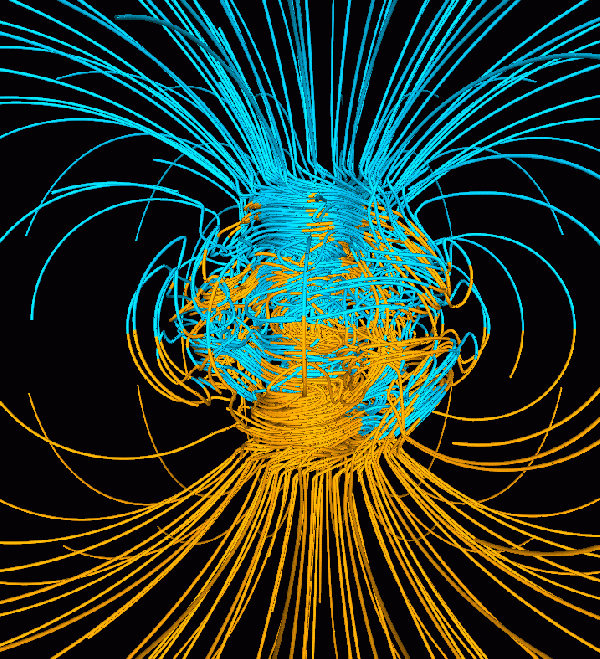
When you picture a magnetic field, you probably think of a sketch from grade school: a magnet with loops from the north to the south pole. By and large, this model holds up, and the earth’s magnetic field operates in the same way. But what if this hadn’t always been the case? New research suggests that, in fact, the earth may have had more than two poles for a tumultuous period of its history. Thus, instead of the symmetrical and familiar magnetic model, roughly 650 million years ago, the earth’s magnetism was a messy model of poles and fields. But how did this work exactly? And how did researchers come to this conclusion? Continue reading → -
Understanding the Milky Way's Magnetic Field
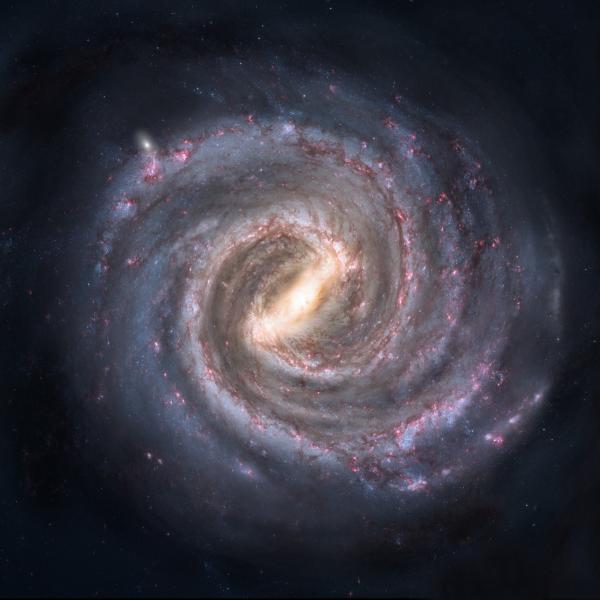
You probably already know that our planet has an intrinsic magnetic field, and you might even know that it’s caused by the earth’s swirling molten core. What you might not know, however, is that plenty of other cosmic objects in the universe have magnetic fields, including our very own Milky Way Galaxy. Scientists think this force plays a supporting role alongside gravity in the galaxy's structure, and it may influence its spiral shape. Magnetic fields also play a part in astronomical events like solar flares and the evolution of stars. Though scientists have conducted research to better understand these important fields created by our galaxy, they still hold many mysteries. Continue reading → -
Earth's Magnetism and the Geodynamo Paradox
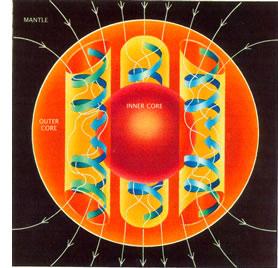
Earth’s magnetic field is one of the reasons our planet is inhabitable. Without the protection of magnetism, Earth would face the dangers of space like cosmic radiation, which would be catastrophic for life on the surface. While we understand the basic process powering the magnetic field, the origins and evolution of our magnetic bubble are a little unclear. So, what processes sustain the magnetic field and how did it evolve? Continue reading → -
Magnetic Space Boots and Science Fiction
Magnets are so useful on Earth that it’s not surprising many science fiction writers find ways for their characters to use them in space. While magnets have the potential to be used in several ways in space, they most often appear as boots. Magnetic boots are useful for space travel where gravity isn’t always there to orient everything. The boots employ large magnets that attract to the metal floor or hulls of a spacecraft allowing the wearer to remain upright in zero gravity. Here are two notable moments in science fiction film and TV where magnetic boots played a prominent role: Continue reading → -
Magnetic Propulsion and the Final Frontier
With help from magnets, we may be able to explore farther and deeper into the final frontier than ever before. This may sound like science fiction, but scientists are already experimenting with electromagnetic propulsion as a possible alternative to chemical launches. So, how does electromagnetic propulsion work? Continue reading → -
What Is Magnetotactic Bacteria?
In 1963, at the University of Pavia in Lombardy, Italy, Salvatore Bellini was observing bog sediments under his microscope. As opposed to the normal movement, Bellini noticed a group of bacteria orienting themselves in a unique direction. Upon further study, he realized that these peculiar microorganisms were moving in the direction of the North Pole. He dubbed them "magnetosensitive bacteria.” Continue reading → -
4 Mesmerizing Magnet Videos
In general, it can be said that videos on the Internet have a certain “magnetic” quality to them, whether you’re watching them to learn new things, to check out the latest Beyoncé music video, or even just to procrastinate. But, they can become even more mesmerizing with the presence of actual magnets. We’ve rounded up 4 of the most mesmerizing magnet videos we could find online...and one bonus one that is only technically on topic, but that you’ll enjoy all the same. Check them out: Continue reading → -
Magnetism and Life Beyond Earth
Conspiracy theories aside, the existence of intelligent lifeforms on other planets has yet to be proven. With that being said, many of those planets may actually be capable of sustaining human life -- if we can somehow travel the distance to inhabit them. Scientists have been searching for other planets that could be conducive to life for quite some time. In fact, NASA's Kepler mission confirmed in 2014 the first Earth-size planet in the “habitable zone” around another star, Kepler-186f, which orbits a red dwarf smaller and cooler than our sun. Planets like this that orbit relatively close to small stars most likely have magnetic fields to protect their surface and any possible life on it from radiation, according to researchers at the University of Washington. But it gets a little more complex than that. Continue reading → -
Visualizing Magnetism With MIMI: Magnetospheric Imaging Instruments
Many of us are aware that plasma is one of the fundamental states of matter. What is not always apparent to us earthlings is that plasma is invisible to the naked eye in certain areas of the universe. But with the help of a tool called MIMI (Magnetospheric Imaging Instrument) NASA can view an entirely new world of material. Continue reading → -
Electromagnets Could Track Movement In Virtual Reality
There are many ways you can use magnets nowadays, from hanging pictures on your fridge to charging your phone. These are commonplace uses for magnets, but a more futuristic application is right around the corner. Soon we might be using magnets not to influence the real world, but a virtual one. Continue reading → -
The Magnetic Engines of Black Holes
At the heart of the Milky Way galaxy lies Sagittarius A-star (Sgr A*), a supermassive black hole about 25,000 light-years from Earth. It was reported in 2015 that this colossal celestial object has partially ordered magnetic fields near its event horizon. But while Earth has a magnetic force field to shield against cosmic debris and radiation, Sgr A*’s magnetic field acts more like an engine that could, in theory, launch jets of intense radiation. Continue reading → -
The Magnetism of Star Wars
Fans of the Star Wars films are counting down the days until the release of Star Wars: The Force Awakens on December 18, 2015 in the US. While the new film promises excitement and the return of beloved characters, there’s no reason to forget the magnetism, both scientific and popular attraction, of the first six films. There are several instances where magnetism plays a role in the Star Wars universe aside from the popularity of the films. Here are a few of our favorites: Continue reading → -
The Science Behind Ferrofluids
While most rare earth magnets are made from the rock hard materials we’re familiar with, not all appear in that classic solid form. Ferrofluid is a stable colloidal suspension of superparamagnetic iron oxide nanoparticles. So, simply, it is a liquid that contains tiny magnetic particles. It’s magnetic properties comes from the magnetized iron oxide it contains. These particles are known as nanoparticles because of their small size -- the particles are actually so small that they stay suspended under normal conditions! Continue reading → -
Why Ghosts Are Magnetic
If you’ve ever been alone in an old house or graveyard at night, it might seem like every little sound is amplified and menacing. The hair on the back of your neck stands up and you feel like someone is watching you. Even if though you don’t believe in ghosts, in certain spooky situations it’s not difficult to imagine a ghostly apparition coming to get you. So, what’s causing your normally rational brain to conjure ghosts and make you feel paranoid? It might be that a nearby electromagnetic field is bringing back the dead. Continue reading → -
The Magnetic Devices Of The Ghostbusters
Many paranormal researchers and ghost hunters have claimed a link between magnetic fields and ghosts, but no scientific evidence supports one. None more famous though than the Ghostbusters of the 1984 film. Even everyone’s four favorite paranormal scientists used electromagnetic devices as they tracked and captured the ghoulish monsters preying on innocent librarians and Sigourney Weaver. How useful would their magnetic devices be in reality? Continue reading → -
What Is A Magnetic Wormhole?
You may remember wormholes as a phenomenon of science fiction capable of transporting objects over great distances due to a wrinkle in space and time from references in pop culture such as Star Trek or Interstellar. But wormholes are much more than works of science fiction as was recently demonstrated by scientists in the physics department at Universitat Autonoma de Barcelona who were able to generate a magnetic wormhole in their lab. Continue reading → -
5 Cool Things That Levitate Using Magnetism
People can already travel by levitating, whether via maglev trains or prototype boards like the Hendo Hoverboard. So, engineers and scientists are making it easier to defy gravity within your own home as well. Magnetic levitation isn’t just for science experiments anymore. Here are several cool examples of objects that float using magnetic levitation (as of 2015; availability may have changed). From toys and tools to furniture, here are a few cool magnetic things you can impress your friends with as they levitate. Continue reading → -
The Role of Magnetism in Binary Systems
Can you imagine if the Earth were orbiting two stars instead of just the Sun? Our solar system would then become a binary solar system and, if science fiction books and movies are to be believed, the weather would be pretty hot. You may remember how a dusty, desert planet called Tatooine from the Star Wars movies orbited two stars. Continue reading →